Posts

Showing posts with the label South East Tasmania

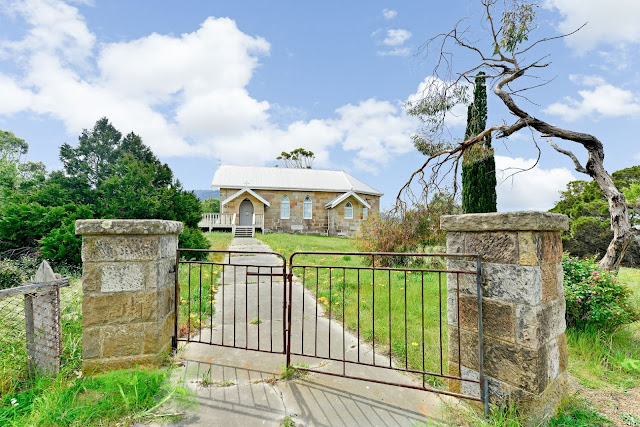
No. 624 - Dunalley - St Martin's Anglican Church - "In grateful memory of the men who fought in the Great War"
Image
Dunalley is village on the Arthur Highway approximately 60 kilometres east of Hobart. It stands on the narrow isthmus connected to the Forestier Peninsula. The Denison Canal runs through the village and connects Blackman Bay and Fredrick Henry Bay. Dunalley was badly affected by bushfires in January 2013 with the town losing over 60 buildings including the Police Station and school. St Martin’s is the only public building left standing after the fires. St Martin’s Anglican has recently featured in the news following its sale. It is one of over 50 churches to be sold to meet the Anglican Church’s commitment to the National Redress Scheme. St Martin’s is an unusual church into two respects. Firstly, it is constructed from stone from the former Government stores at the old Coal Mines penal station at Saltwater River, which is now a UNESCO World Heritage site. Secondly, the church was built as a memorial to the men of the district who fought and died in the Great War. As such, the buildin...

No. 281 - The Separate Prison Chapel at Port Arthur

Image
The chapel inside the Separate Prison at Port Arthur must be the most extraordinary place of worship in Tasmania. It is a reconstruction of the original chapel that was destroyed by bushfires at Port Arthur in the late 19th century. Its design was based on the chapel at Pentonville prison built in 1842 in North London. Pentonville was an experimental prison that modelled the concept of separate confinement first developed at the Eastern State Penitentiary in Philadelphia. In Britain the ‘separate system’ was adopted as a means to deal with the rapid increase in prisoner numbers caused by the ending of capital punishment for many crimes and the reduction in transportation of convicts. The intention of the separate design was to keep prisoners isolated from each other. The cells were built to prevent transmission of sound and ensure total separation. The system found its way to Tasmania with the construction of the separate prison at Port Arthur in 1853 to accommodate the most harden...

No. 269 - St David's at Port Arthur - 'No Better Omen'

Image
St David’s is a unique Tasmanian church in that it is a functioning church within the precinct of a historic tourist site. In was built in 1927 to replace the original convict church that was gutted by fire in 1884. After the closure of the Port Arthur prison in 1877, the site was renamed Carnarvon, after the 4th Earl of Carnarvon, who had been the British Secretary of State for the Colonies. During the 1880s, land was auctioned and a township developed. Devastating bushfires in 1895 and 1897 destroyed many old buildings and gutted the Penitentiary, Separate Prison and Hospital. After the destruction of the convict church, for a time, residents worshipped in the old Asylum which also served as the town hall. By the 1920’s residents of Port Arthur formed a committee to establish a new Anglican church for the township. The laying of the foundation stone for the new church took place in May 1927. The heavy rains at the time were seen as a good omen: “It was raining heavily throughout the ...