Posts

Showing posts with the label 1890-1899

No. 1035 - Lower Mount Hicks - Methodist Church (1890-1972)

Image
Lower Mount Hicks is a rural settlement situated approximately 10 kilometres south of Wynyard. Two churches were built in the  Mount Hicks district; a United Methodist Free Church that opened in the 1890s and a Gospel Chapel which was established in the 1950s. Both churches have closed. Methodists services began at Mount Hicks in the late 1880s which led to the construction of a church on what is now the Old Mount Hicks Road in the vicinity of the cemetery.  In November 1890 the Launceston Examiner reported: "Mr W. Peart, of Wynyard, is erecting a church for the Free Methodists on land kindly given by Mr W. Hyland, and this will supply a long-felt want in the district." The opening of the church took place on Sunday 14 December 1890. The occasion was reported by the Launceston Examiner as well as the Wellington Times and Agricultural and Mining Gazette: “The new Methodist Free Church was opened on Sunday morning last by the Rev. W. H. Bowe, who conducted the service; the Rev....

No. 1034 - Longley - St Luke's Anglican Church (1893-1897) 'Baptism by Fire'

Image
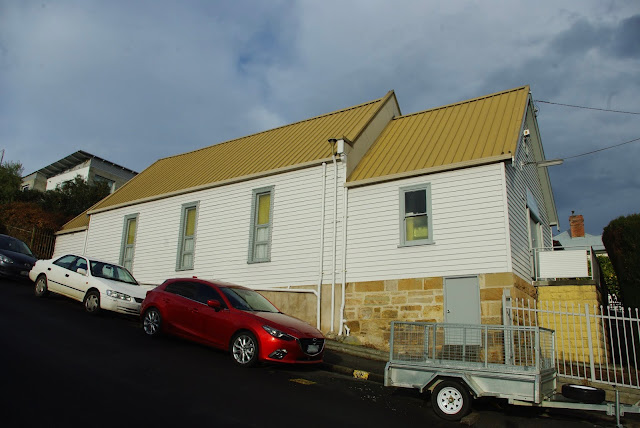
Longley is a rural settlement approximately 20 kilometres south of Hobart. The area was originally named Leslie, a name that has been preserved by Leslie Hill, on the eastern side of Longley. Three Anglican churches were built at Longley, all of which were destroyed by bushfires. The first church was built in 1892 and consecrated and dedicated to St. Luke in February of the following year. This building was lost in the ‘great bushfires’ that swept across southern Tasmania in the summer of 1897/8. A second church was built and rededicated in 1898. This building was similarly destroyed in a bushfire in 1931. The third church, built in 1932, was lost in the 1967 bushfires. This building was not replaced. The focus of this article is on Longley’s first Anglican church which only stood for a little over four years. The church was a small weatherboard structure build by ‘Mr Stuart’. The church’s foundation stone was ceremonially laid by Bishop Montgomery on Tuesday 15 March 1892. The Mer...

No. 1006 - West Hobart - Warwick Street Seventh-Day Adventist Church (1896)

Image
West Hobart is an inner-city suburb of Hobart immediately west of the city centre. The suburb occupies the high ground below Knocklofty Hill. The Seventh-day Adventist Church was established in Tasmania in 1888. The denomination originated in the USA in the 1860s and in 1885 a group of Adventists travelled to Australia and began preaching in Melbourne. After a church group was established in Melbourne in 1886 members moved on to Sydney, Adelaide and Hobart. Public tent meetings were held in Sandy Bay in 1888 which led to the establishment of a church at Collinsvale followed by Hobart in 1896 and at Launceston shortly after the turn of the 20th century. The Upper Warwick Street church was opened on Friday 19 June 1896 with a dedicatory service held on Saturday morning. In 1904 a section of the church was used as an Adventist schoolroom. The original school was established by Miss Katie Judge in two rented rooms in Harrington Street around 1901. In 1933 the school was relocated to Fleet ...

No. 1005 - North Hobart - St Margaret's (1896-2007)

Image
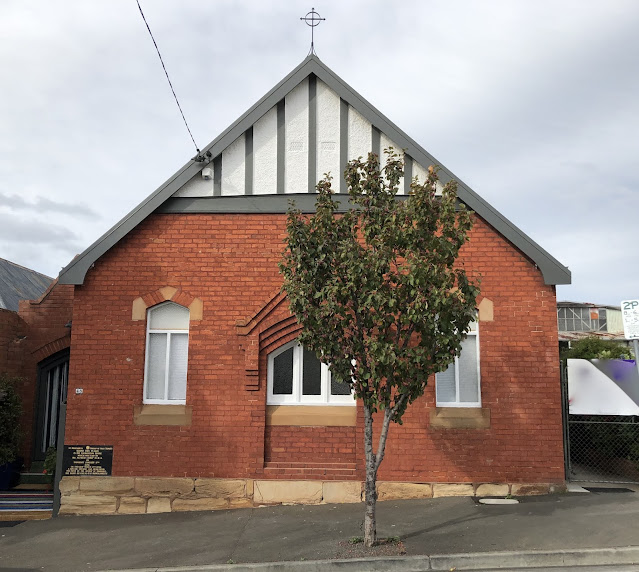
The suburb of North Hobart, as the same suggests, is on the northern fringe of the city centre. It has evolved into a mixed residential and commercial area since it was developed in the 1830s. St Margaret’s Mission on Federal Street (previously Colville Street) was established in 1885 as a 'mission room' located in neighbouring Ware street. In 1896 the Ware Street Mission was replaced by the ‘Holy Trinity Mission Room’ built on Federal Street.  The 'Mission' was became known as St Margaret’s Mission Hall after it was dedicated by Bishop Hay in 1926. The Mercury records the laying of the Mission’s foundation stone in January 1896: “On Saturday afternoon the foundation or memorial stone of a new mission-room, in connection with Holy Trinity Church, was laid in Colville-street North by Mr. Alfred Crisp, M.H.A. for the district, in the presence of a goodly number of people. The new building is to be 60ft. by 25ft., and is being erected in substitution for the temporary room...

No. 981 - Flowerdale Methodist Church (1891-1965)

Image
Flowerdale is a rural settlement approximately 7 kilometres west of Wynyard. The settlement is centred near the confluence of the Flowerdale and Inglis rivers. Flowerdale Creek was named by the Van Diemen's Land Company and first appears on the Franklands map of 1837. The first Methodist service at Flowerdale took place in about 1870 in the home of Mr John Ridge. Mr Ridge later built a small hall for use by anyone who wanted to preach the Gospel. The Methodists used this hall for a time before building their own church in 1891. The opening of the Flowedale Methodist church was recorded by Wellington Times and Agricultural and Mining Gazette and this report provides some detail about the the building: “Quite an event in the history of Flowerdale has taken place during this week, and may justly claim to be the most important ceremony in regard to the numbers concerned, and the object achieved, yet attempted in this picturesque and flourishing district. Any one unacquainted with the ...

No. 962 - Claude Road Methodist Church (1890-1974) - "The Church in the Greenwood"

Image
Claude Road is a rural settlement approximately 10 kilometres south of Sheffield centred on the Dasher River. The area has some history of some mining but logging was once a significant industry. The settlement once had a Methodist Church but the only tangible reminder of its existence is the Claude Road Cemetery. The church opened in 1890 although Methodist services had been held in homes prior to this. A correspondent writing to the Colonist in September 1890 provides a rich source of information about the church’s establishment: “…About five or six miles from Sheffield, on the road to Middlesex, you pass over the Dasher Bridge, and here, along and around the valley of the Dasher, a settlement has gradually been forming and rising into more notice and importance. ….For some years past services have been held in connection with the Wesleyan Church, and I think it has been in connection with those services that the name of Claude-Road has gradually been assumed and adopted. On Sunda...

No. 872 - Sisters Creek - Methodist [Uniting] Church (1893-2008)

Image
Sisters Creek is a farming district on the Bass Highway 6 kilometres west of Boat Harbour. An 1851 map of Tasmania names a range of hills in the vicinity as the “Sisters”. The name seems to have been applied to the nearby creek. The first Methodist services at Sisters Creek took place in 1890 “under the auspices of the Wesleyan church at Stanley”. In 1893 a church was built which also served as a schoolroom until the Sisters Creek State school was built in 1907. The church was built on land provided by Mr R.A. Pearson and it was intended that the building be made available for use by all religious denominations. In 1897 the land and the building was taken over by a Methodist Trust. The church was officially opened on Sunday 25 June 1893. The event was recorded by the Wellington Times and Agricultural and Mining Gazette: “The opening ceremonies….took place on Sunday last when the Rev. T. J. Payne preached to a good congregation at 11 a.m. and the Rev, C.G. Wilkinson in the evening t...

No. 867 - Gladstone - St Michael's Catholic Church (c.1895-1969)

Image
Gladstone is a small and remote settlement situated on the banks of the Ringarooma River in north east Tasmania. It was first settled in 1870 by tin miners; a large number of whom were Chinese. In 1880 the discovery of gold in the area boosted the town’s population but once this was exhausted tin mining became the mainstay of the local economy. Gladstone is named after British Prime Minister, William Ewart Gladstone, who had also served as Colonial Secretary. At its peak three religious denominations were represented in the town with Catholic, Anglican and Presbyterian churches established. Gladstone’s churches have closed but two of the buildings have survived and have been converted into houses.   In the 1880s religious services took place in Gladstone’s Town Hall. In 1884 a visitor to the town commented: “The township possesses a Town Hall, a corrugated iron building fifty feet long, and twenty-four feet wide; it has a capital floor and a small stage. This building does dut...

No. 836 - Devonport - Steele Street Salvation Army Hall

Image
Devonport was created in 1890 with the merging of two towns on the opposite banks of the Mersey River; Formby on the west bank and Torquay on the east bank. The area was first settled in the 1840s. The Salvation Army arrived in West Devonport in 1890, only seven years after it had established bases in Launceston and Hobart. The public reception to the ‘Army’ in Tasmania was initially hostile and established churches and the middle-class were wary of its disruptive proselytising. The raucous nature of the ‘Army’s’ open-air gatherings and street processions tended to attract the working classes and people on the fringes of society. In Launceston and Hobart, processions were shadowed by a ‘skeleton army’ that parodied its marches and disturbed its meetings; sometimes violently. In Hobart the leader of the ‘Army’, Captain Gallagher, as well as others, were imprisoned for breaching municipal by-laws but were released after the intervention of the Attorney General. At Devonport the react...

No. 794 - Leprena Congregational Church (1899 - c.1938)

Image
Leprena is a former settlement on the northern end of the Recherche Bay. The word 'Leprena' is of Tasmanian Aboriginal origin and means 'home'. From the late 19th century up until the 1940s Leprena had an active timber-milling industry. The settlement’s population peaked around the turn of the 20th century by which time Leprena had acquired a school, a public hall, post office, general store and a church. The saw mill's closure in 1938 and destructive bush fires in the following year brought an end to the settlement. There is little information about Leprena’s Congregational church which opened in July 1899. A brief article describing the church’s opening appears the Hobart Mercury. It was an unusual event given the absence of the minister, Reverend Joseph Ebery, who sent his apologies. In lieu of a formal religious ceremony, the occasion was marked by an informal celebration. The Mercury’s correspondent at Leprena reported: “A concert and coffee soiree was held...