Posts

Showing posts with the label Former church

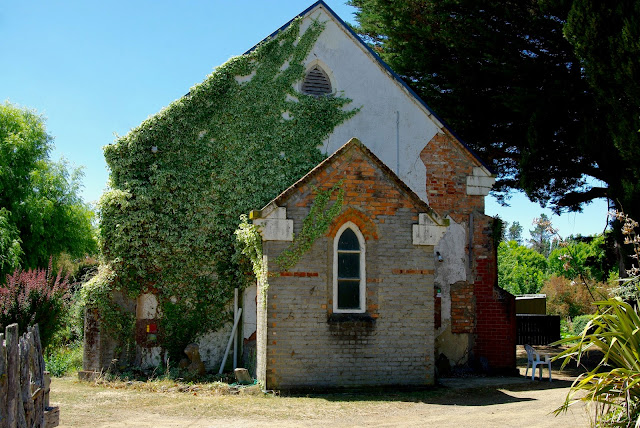
No. 111 - St Mary's Evandale - 'Training up the Little Ones'

Image
The establishment of a Catholic Church at Evandale is usually dated to ‘around 1863’. However, a report in the Examiner from November 1859 clearly dates this as four years earlier: “On Sunday last one of those pleasing and joyful events which gladdens the heart of the Christian took place in that charming and delightfully situated township, Evandale. For some time past the Catholics of the district, aided by their zealous pastor, have had in contemplation the erection of a church, where they might meet to worship God, and train up their little ones in the faith of their fathers. The good work is now happily completed. The church was solemnly opened on Sunday last by the Rev. M. O'Callaghan, whose lucid and brilliant discourse was listened to with breathless attention by a numerous audience, many of whom came from Launceston, thus testifying at once their zeal for God's house, and their respect and reverence for their priest and spiritual director. Too much praise cannot be give...

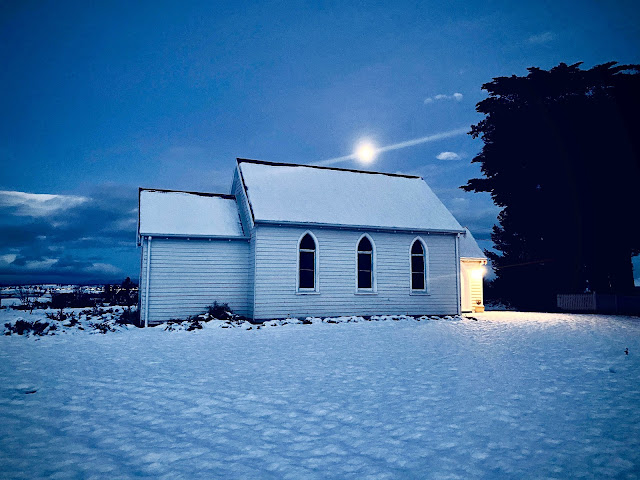
No. 100 - Former Wesleyan Chapel Campbell Town - 'A Fine Looking Building'

Image
In the 1850’s, Campbell Town claimed to be the fourth largest town in Tasmania. It was also one of four garrison towns on the route between Launceston and Hobart. It became a policing centre for overseeing the capture of escaped convicts and developed into a centre for the coaching industry and hotels serving travellers on the route connecting the north and south of the island. Religious groups were active in the town soon after its establishment. The first Methodist service was conducted in 1832 by the Reverend Nathaniel Turner. Early services were held in the old court house at the bottom of Bridge Street. Turner, together with his colleague John Manton, set out to establish Methodism in the north of Tasmania with the support of Samuel Horton of Somercotes who became the trustee of the first chapel in Campbell town and who also funded the first Sunday school there. A feature of the town’s religious community was the high degree of interdenominational support and the building of t...

No. 64 - St. John's Anglican Church - White Hills (1917)

Image
White Hills is a rural area within Greater Launceston which lies about 15 kilometres south-east of the city. The first Anglican church at White Hills was dedicated to St. Paul and was officially opened on Sunday 14 January 1844. It was a brick building with lancet windows and was situated on a hilltop near the present wooden church. It was built at a cost of £900, assisted by a government grant of £410. The diary of Reverend John Mereweather, the first permanent rector, described the church as “pretty enough with its lancet windows”. However Mereweather complained about the building’s dampness, poor construction and the lack of a communion table. Although built in 1844, the church was not consecrated until 1857. By the late 1870s problems with the building’s foundations made it unsafe for services. The church was abandoned in about 1882. after this services were held in a nearby schoolroom as well as at private houses. The foundations of the old church were still visible in 1917 whe...

No. 63 - Launceston's former York Street Baptist Church - "No Ordinary Man"

Image
The former York Street Baptist church is not easily recognisable from the street and the boarded up gothic windows visible on the side of the building are the only evidence that a magnificent church was once located here. The origin and early growth of the ‘Particular’ Baptists in Tasmania is largely due to the work of Reverend Henry Dowling. Dowling had been the pastor of a Baptist church in England before he arrived in Tasmania 1834 at the age of 60. He immediately commenced work as a Baptist missionary and conducted baptisms in the Rivers Derwent, Ouse, and the North Esk. In December 1840 the York Street Baptist Church was opened for worship with Henry Dowling as pastor. By 1847 the church found itself in severe financial difficulties due to the burden of a £1000 mortgage raised to purchase land and build the church. An appeal was made for public subscriptions and collectors were appointed. The church was ultimately freed from debt partly at the cost of selling the Baptist m...

No. 51 - Hagley Presbyterian Church - Built with Bricks of a Brewery

Image
Presbyterian services were held in Hagley as early as 1853. Services were held in a Methodist Chapel and also at the old Anglican (Church of England) Church which was eventually purchased by the Presbyterians in the 1870’s. This was the same chapel that had served as Hagley’s first school from 1855. There seemed to be some symbiosis in this arrangement: "As the school was held in the church, services such as marriages caused breaks in the school time table - breaks that were appreciated by the scholars.” (Examiner ) With the needs of a growing congregation, the old Anglican Church was demolished and a new brick building was constructed. The bricks used to build the new church came from a demolished brewery, probably from Longford. It was opened in December 1879.  During the period of construction, the Presbyterians once shared the Methodist Church, which was a community with which they had a long standing good relationship. Like so many rural churches, the Presbyterians ...

No. 37 - Youngtown Primitive Methodist Church - From Furniture Van to Church

Image
The ‘Young Town’ Church was the first Primitive Methodist Chapel in Tasmania, established in 1859. It had major repairs undertaken in 1936 and the Craythorne Road Chapel from Rosevears was purchased and added as a Sunday School Hall in 1949. Sadly, the thriving community which sustained it for so long dwindled away, and like so many of these small churches, has become a private residence. A report in the Examiner in 1937, following its’ reopening, outlined the ‘Young Town’ place in the history of the early Methodist movement in Tasmania: “… little chapel has stood at Young Town, and it provides one of the few remaining links with Primitive Methodism which existed before the wider union of 1902. In 1810 two Methodist local preachers in England, Hugh Bourne and William Clowes, separated from the Wesleyan Methodist connection and founded the Primitive Methodist Church, which from the first became noted for its intensely evangelical spirit. It differed from the Wesleyan Church in that the...

No. 27 - Frankford - Primitive Methodist Church (1886) 'An unpretending structure'

Image
Frankford is a rural settlement about 40 kilometres north west of Launceston. The old village was once used as a way station. The Frankford Road links the West Tamar with the Port Sorell area with Frankford being the largest settlement on the route. In the 19th century Frankford's remoteness was exacerbated by the extremely poor state of the roads. This gave the district an atmosphere of isolation although it was less than 20 kilometres from mining town of Beaconsfield. A visitor described the area in 1884: “Soon after we pass the pretty little schoolhouse in course of erection; a few neglected paddocks, full of firewood and all abominations, show absentees, and then we come to the farm of the district (Mr. Hamilton's), but it does not fall to the lot of all settlers to have such a lot of stalwart sons to help him; this seems a good farm, well farmed. The next location is Mr. Kerns, storekeeper, etc. He seems to have a large extent cleared, but the brake fern [sic] seems a terr...

No. 7 - Baptist Church Dysart - Deceiving Appearances

Image
This is the former Baptist Church at Dysart which was built in 1863 by Henry Speke, who offered the building for use by any denomination provided the minister did not wear a gown or use a prayer book. Given these terms and conditions, the Church of England felt obliged to provide their own church in Dysart! It seems that it has not altered much when comparing it to the photo taken around 1890. But appearances are deceiving. It was at one time in a ruinous state, abandoned and badly damaged by fire. In 1948 ownership of the church was traced to the Baptist Union which opted to transfer the building to the local council given the cost of repair. This became the first church in Tasmania to be given away and it was transformed into a community hall and and war memorial. It is heritage listed and described as "Unusual Georgian stone church. Dressed stone quoins and reveals to openings with decked stone walls. Iron gable roof. Main facade has two round head entry doors in each corn...

No. 4 - St Anne's Anglican Church, Dysart - Stories in the Stones

Image
This rather quaint Gothic Revival church on Constitution Hill in Dysart was opened by Bishop Bromby in 1872 and consecrated in 1876. It was designed by Francis Butler, who was Director of Public Works at this time. It was deconsecrated in 2007 and sold shortly after this. Dysart was formerly known as Shepton Montacute, just south of Green Ponds, now known as Kempton. Its current name is taken from estate Dysart Park in Kempton, which in turn takes its name from Dysart near Edinburgh. As can be seen from the photographs, the church is in a very poor state of repair and its renovation was delayed by a development scandal in 2014. (see the story in the link to The Mercury at the bottom of the page). Structural problems and constant repairs seem to have been a big part of this church’s history. There are reports in the Mercury in 1902 that mention the east wall leaning dangerously inwards. In 1904 there is mention of debts arising from replacing or repairing the roof. It is evident t...