Posts

Showing posts with the label Congregational

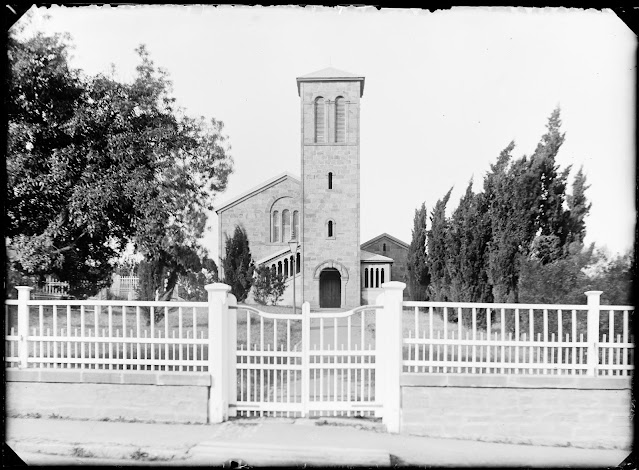
No. 1081 - Hobart - Brisbane Street Congregational Church (1832-1872)

Image
The former Brisbane Street Congregational Church was demolished in 1911. It was a building of some significance being the first Congregational church built in Australia. One of the most significant figures in the establishment of Congregationalism in Tasmania was Henry Hopkins. Hopkins arrived in Hobart in 1822 and soon established himself as a successful businessman. He became the leader of a small group of independent Christians who wanted to establish a church of their own. It was Hopkins who in 1828 approached the London Missionary Society for help in providing a minister. In 1830, in response to Henry Hopkins' request, Reverend Frederick Miller arrived in Hobart. For 25 years Miller was secretary of the Bible Society, worked with the Sunday School Union and the Tract Society, established the Bethel Union and was an originator of the Colonial Missions Society, while also ministering to the Brisbane Street Church, which opened in 1832. On 17 October 1830 Miller held his first s...
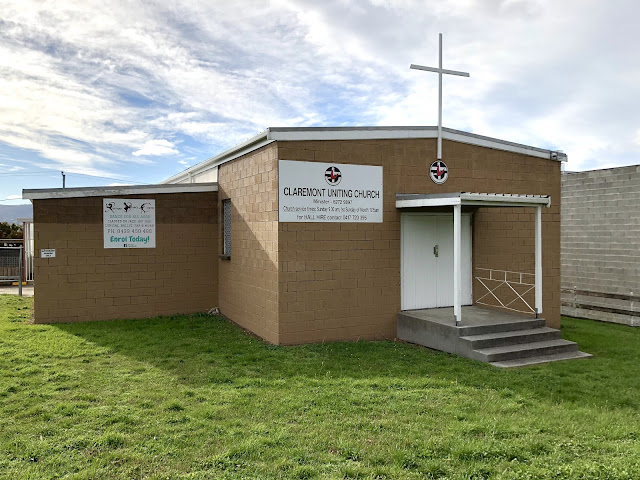
No. 959 - Claremont - Congregational Church Hall (1915-1963)

Image
Claremont is a suburb of the City of Glenorchy within the Greater Hobart region. It is named after Claremont House built in the 1830s by Henry Bilton. Claremont was once the site of an army training camp established during the Great War. At this time the area had only a few scattered houses and a railway station in a largely rural setting. From the 1950s public housing was built at Claremont which resulted in significant population growth. The Congregational Church was first active at nearby Hestercombe in the 1830s. In 1911 a site for a Congregational Mission Hall was purchased at a junction adjacent to the Claremont Recreation Ground. From 1913 services were conducted in a private house before being transferred to the Claremont school. The foundation stone for the Mission Hall was ceremonially laid on Wednesday 10 March 1914. The Mercury published a brief report of the event: “The stone of the Congregational Mission-hall at Claremont was laid on Wednesday afternoon by Rev. W. Perr...

No. 828 - Lindisfarne Uniting Church (Congregational)

Image
Lindisfarne is an eastern shore suburb of Hobart. It was named after "Lindisfarne House", a property situated in the adjoining suburb of Rosny. The area was originally known as Beltana but this was changed to Lindisfarne in 1903. The foundation stone of the Lindisfarne Congregational Church was laid on Wednesday 27 May 1903. The Tasmanian News reported: “The foundation-stone of a new Congregational Church at Beltana was laid this afternoon at 3 o’clock by the Rev. George Clarke. Steamers left Hobart and Bellerive at 2.15pm and conveyed a number of adherents of the Congregational Church, the whole ceremony being carried out in orthodox manner without a hitch”. “Mr R, Flack Ricards, F.R.V.I.A., is the architect of the building, which Is to be 20ft wide, by 35ft long. The vestry at the back will be 8ft X 14ft, with a porch and side entrance. The building, when completed, will be in a modified early English style, but the construction will be kept as simple as possible. It will...

No. 825 - New Town Congregational Church

Image
New Town is a northern suburb of Hobart. It is also one of Hobart’s oldest suburbs and consequently the area contains many historic churches. New Town became a municipality in 1907 but was absorbed into greater Hobart in the 1920s when its municipal status was relinquished. New Town’s former Congregational Church is a lesser known church designed by James Blackburn (1803–1854), civil engineer, surveyor and architect. Blackburn was transported to Van Dieman’s Land for forgery and arrived in Hobart in 1833. He was employed in the Department of Roads and Bridges until pardoned in 1841. Blackburn was one of Tasmania's most original, technically proficient and imaginative architects. Examples of his work include Holy Trinity Hobart, the Congregational Chapels at Bagdad and Cambridge; St Mark's Pontville, St Matthew's Glenorchy, and Sorell Presbyterian Church. The New Town Congregational Church reflects Blackburn’s hallmark Victorian Romanesque style. The church’s closure and ...

No. 809 - Bellerive - Kangaroo Point Mission (1860-1909)

Image
Bellerive is a suburb of the City of Clarence within the area of Greater Hobart. Located on the Eastern shore of the Derwent River, the settlement was originally called Kangaroo Point. Bellerive’s Uniting Church, previously a Congregational Church, opened in January 1910. This replaced an earlier church built in 1860 close to the original Bellerive State school. Known as the Kangaroo Point Congregational Mission, its purpose was to house Sabbath school classes as well provide a place of worship for supporters of the Congregational community.  The first Congregational services at Kangaroo Point were held in the home of Mr Lane which was also used as a venue for Sunday school.  In 1857 services were held in in the State School until 1859 when a room in the Waterman's Arms was used. For many years Mr Joseph Bealby rowed across the Derwent to conduct Sunday school classes. The foundation stone for the Mission was laid on Wednesday 18 April 1860 by Henry Hopkins, who is credited w...

No. 795 - Bellerive Uniting (Congregational) Church

Image
Bellerive is a suburb of the City of Clarence and part of the greater Hobart area. It is located on the Eastern shore of the Derwent River. Originally it was named Kangaroo Point but in the 1830s this was changed to Bellerive, meaning ‘beautiful shore’. Bellerive’s Uniting church opened in January 1910 as a Congregational church, replacing an earlier church built in 1860 near the original State school on King Street. The foundation stone for the new church was laid on Friday 15 October 1909. The Hobart Mercury reported: “An exceedingly interesting ceremony took place yesterday at Bellerive in connection with the laying of the foundation-stone of the new Congregational Church in that suburb. A special boat from town conveyed a large number of members of the church to the other shore. Among those who attended were Mr. S. Clemes, representing the Council of Churches. Hon. John Hope, representing the Government. The ceremony of laying the stone was performed by Sir Albert Spicer, Bart., ...

No. 794 - Leprena Congregational Church (1899 - c.1938)

Image
Leprena is a former settlement on the northern end of the Recherche Bay. The word 'Leprena' is of Tasmanian Aboriginal origin and means 'home'. From the late 19th century up until the 1940s Leprena had an active timber-milling industry. The settlement’s population peaked around the turn of the 20th century by which time Leprena had acquired a school, a public hall, post office, general store and a church. The saw mill's closure in 1938 and destructive bush fires in the following year brought an end to the settlement. There is little information about Leprena’s Congregational church which opened in July 1899. A brief article describing the church’s opening appears the Hobart Mercury. It was an unusual event given the absence of the minister, Reverend Joseph Ebery, who sent his apologies. In lieu of a formal religious ceremony, the occasion was marked by an informal celebration. The Mercury’s correspondent at Leprena reported: “A concert and coffee soiree was held...