Posts

Showing posts with the label 2000-2010

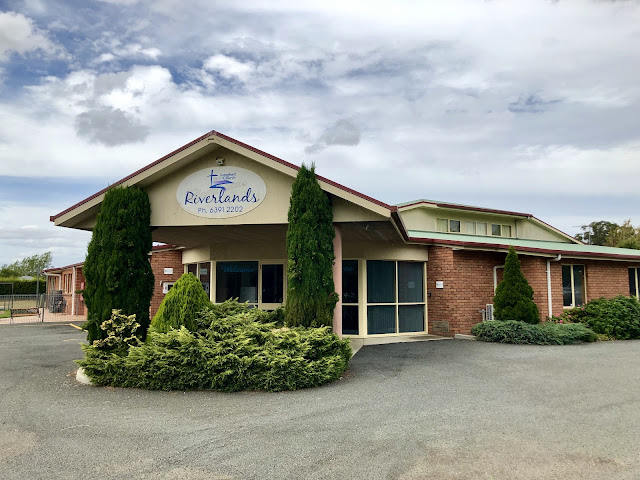
No. 1055 - Longford - Riverlands Church
Image
Longford is an historical country town approximately 25 kilometres south of Launceston. The district around Longford was first known as the Norfolk Plains after the Norfolk Islanders who were resettled here in 1813. The settlement was originally called Latour and in 1833 it was renamed Longford Riverlands Church is the successor to the Longford Baptist Church. The Baptist church was formally established in 1880 with opening of the Longford Tabernacle at 41 Wellington Street. In 1999 a new church and community centre was built to meet the needs of the Baptist community. The Longford Tabernacle was sold and a new building was erected at 159 Wellington Street. Initially the church retained its former name ‘Longford Baptist Church’ and the building only became known as ‘Riverlands’. After 2004, the name ‘Riverlands’ became the name of the church as well. Additional information about this church is welcomed as all articles are updated. I can be contacted through this page or my Facebook pag...
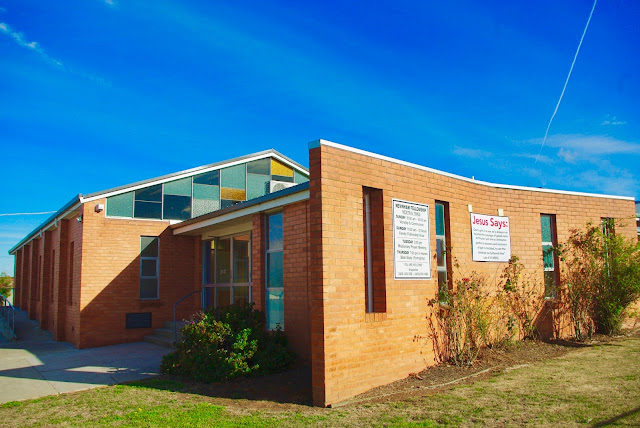
No. 1014 - Newnham - Newnham Fellowship

Image
Newnham is a northern suburb of the city of Launceston. Newnham was originally part of the municipality of Lilydale before it was proclaimed a town in 1946. There are several active Christian communities in Newnham including a Uniting Church, an Anglican church and a Church of Christ. The Newnham Fellowship is located in the premises of a former Catholic Church, Our Lady Help of Christians, which opened in 1968. Newnham Fellowship falls under the umbrella of the Association of Christian Community Churches in Victoria and Tasmania. The association describes itself as “a movement of like-minded local churches, predominantly of a Christian Brethren heritage, that have united under a common vision and mission, set of beliefs and core values”. The Christian Brethren, originated in Great Britain in the 1820s. By the mid 19th century the movement had spread to Australia, with the first revival meetings held in Tasmania from 1869. As a result, fellowships were formed in Hobart, Launceston, t...

No. 965 - Rocherlea - The House of Prayer Bible Fellowship International

Image
Rocherlea is an outer northeastern suburb of Launceston. The area was previously known as Rocher’s Lane, which was the location of Rocklands, a house built by Charles Rocher, a barrister of the Supreme Court. The suburb was developed in the 1960s with the construction of public housing. The House of Prayer Bible Fellowship International is a non-denominal church located in a former supermarket on Blackwood Drive. The church was founded by Pastor Abdul-Karim Kamara. The congregation met at a number of locations before it found a permanent home at Rocherlea in 2015. A feature of the church is its multicultural character with members of the congregation drawn from across the globe and this is reflected in the church’s name.  Additional information about this church is welcomed as all articles are continually updated. I can be contacted through this page or my Facebook page "Churches of Tasmania" which is linked here: Churches of Tasmania . Sources and links: The Examiner, Sunday...

No. 942 - Hobart North - Hope Christian Centre

Image
The Hope Christian Centre is located in the former Sunbeam warehouse on Tasma Street, North Hobart. The fellowship moved from the Murray Street Gospel Chapel in December 2003, after 18 months of repurposing the building. The Hope Christian Centre falls under the umbrella of the Association of Christian Community Churches in Victoria and Tasmania. The association describes itself as “a movement of like-minded local churches, predominantly of a Christian Brethren heritage, that have united under a common vision and mission, set of beliefs and core values”. The Christian Brethren, also known as the Plymouth Brethren, originated in Great Britain in the 1820s. By the mid 19th century the movement had spread to Australia, with the first revival meetings held in Tasmania from 1869. As a result, fellowships were formed in Hobart, Launceston, the Huon Valley, Smithton, Sheffield, Wynyard, Burnie and Scottsdale by the end of the 1870s. The Brethren placed an emphasis on weekly communion, the bap...

No. 911 - George Town - "All Saints' George Town"

Image
George Town is one of the oldest towns in Australia and is the second oldest town in Tasmania. It is therefore surprising that many of the town’s churches were only established after World War Two. The Anglicans and Methodists had an early presence but Catholic and Presbyterian churches were only established in the 1950s and other religious denominations arrived after the 1970s. The establishment of Launceston as the administrative centre of the North in the early years of the colony meant that George Town was destined to remain a backwater until more recent times. The construction of an aluminium smelter at nearby Bell Bay in the 1950s as well as the development of industry south of the town, accelerated George Town’s population growth in the post-war era. George Town’s Anglican church is a modern, functional and austere building therefore it may be surprising to learn that its origins go back to the first European settlement in northern Tasmania. It is located close to the site where...

No. 891 - Cambridge - Kingdom Hall

Image
Cambridge is a suburb in the greater Hobart area and which in recent years has developed into an industrial estate and a commuter town. In the very early period the Cambridge area was known as Hollow Tree. The Cambridge Kingdom Hall is located on the old Cambridge road approximately 1 kilometre north-east of Mornington. The Hall replaces a Kingdom Hall built at Derinya Street, Mornington, in the 1970s. The old hall is now the premises of the Bugeido Karate School. The Jehovah's Witness diverges from the mainstream doctrines of Christianity in that it is a non-trinitarian tradition. Jehovah's Witnesses believe their denomination is a restoration of first-century Christianity. It is a ‘closed’ church and its practices have led its critics to regard it as a sect. The historical persecution of members of the Jehovah’s Witness in many countries, including Australia, has further contributed to the denomination maintaining a low profile in the media. For this reason the history of th...

No. 890 - Detention - Detention River Christian Community

Image
Detention is a rural area on the Bass Highway approximately 30 kilometres west of Wynyard. It takes its name from the Detention River, originally called the Tret River. In 1826, when the river was in flood, a party of surveyors from the Van Diemen's Land Company were stranded for several days, thereafter it became the known as the Detention River. The Detention River Christian Community, (previously known as the Rocky Cape Christian Community) is located in the former Detention River Baptist Youth Camp which was acquired in 2017. It is an Anabaptist community, a conservative Christian group with roots going back to 16th century Europe. Its members are expected to give up their possessions for the common good. The Tasmanian community was established in 2005 by the Elmendorf Christian Community of Minnesota. The Detention River Christian Community describes itself as: “A self funded Christian Community that provides spiritual support in the areas of loneliness, marginalisation, famil...

No. 839 - Devonport Community Church

Image
Devonport was created in 1890 with the merging of two towns on the opposite banks of the Mersey River; Formby on the west bank and Torquay on the east bank. The area was first settled in the 1840s. Over thirty places of worship have been established at Devonport since settlement began. The Devonport Community Church is a more recent addition being established in the 1990s. The church is located on Formby Road in a converted building which includes a Christian bookshop. The Devonport Community Church describes itself as a meeting place “for the worship of God, the preaching of the gospel, Christian fellowship and care, as well as being an outreach to those in need”. The church does not appear to be connected to any of recognised denominations but can be classified as an independent evangelical church. Additional information about this church and the building is most welcome as all articles are continually updated. I can be contacted through this page or my Facebook page "Churc...

No. 814 - Warrane - St Peter's Lutheran Church

Image
Warrane is an eastern shore suburb of Hobart that was established by the Housing Department in the late 1940s and early 1950s. Warrane is an Aboriginal word meaning 'blue sky’. The name was first used for postal purposes for the Montague Bay area before it was transferred to its present locality in the 1940s. The St Peter’s Lutheran Church is located in St Peter’s Centre in the grounds of Eastside Lutheran College at Warrane. Hobart’s first Lutheran congregation was formed in 1949 by post-war migrants. In 1973 the Davey Street Methodist church was purchased and renamed St Peter’s. The cost of maintaining the 1871 building contributed to the church’s relocation to Warrane where a Lutheran school had been established in 1985. The old Davey Street church was sold and is now owned by Hillsong. Additional information about this church is most welcome as all articles are continually updated. I can be contacted through this page or my Facebook page "Churches of Tasmania" whic...

No. 803 - Rokeby - The Grace Church and The Grace Centre

Image
Rokeby is an eastern suburb of Greater Hobart which falls under the City of Clarence local government area. Rokeby was a small village until the 1970s when the State Government Housing Department established a large housing estate. The area is is named after "Rokeby House" which was built by George Stokell in 1830. Rokeby is a village in Yorkshire, England. The origins of the Grace Church date to 1958 when it was known as the Assembly of God. Around 2010 the church moved from Hobart to Mornington where rented premises were used as a place of worship for about five years. Services are currently held in the Performing Arts Centre at the Emmanuel Christian School at Rokeby.   In 2015 the Rokeby Tavern was purchased by the Grace Church. It is not used as a place of worship but has been transformed into a community meeting hub, as a gift by the church to the local community.  The interesting story of the pub’s renovation and conversion into a church is recounted in a program reco...

No. 687 - Ranelagh - St Mary of the Cross

Image
Ranelagh is a township situated on the Huon River approximately 2 kilometres north of Huonville. Formerly known as Ranelagh Junction it had previously shared the name ‘Victoria’ with neighbouring Huonville. Four religious denominations have been represented at Ranelagh including Methodist, Anglican, the Salvation Army and Catholic. Ranelagh’s first Catholic church; Sacred Heart, was built in 1901 [ see No. 680 ]. In 2014 the original church was replaced by a modern building, St Mary of the Cross, dedicated to Saint Mary Mackillop. The church was officially blessed and opened by Archbishop Porteous on Sunday 10 August 2014. The church is a part of the Huon parish which comprises of four churches, including St Joseph’s in Geeveston, Mary our Hope in Dover and St James’ in Cygnet. A history of the Catholic church in the Huon region can be found on the link at the end of this page. Photograph courtesy of the Huon catholic Parish Photograph courtesy of the Huon ca...

No. 663 - Mornington - MacKillop College - 'St Joseph's Chapel'

Image
Mornington is an eastern shore suburb of Hobart that was established by the Housing Department in the late 1960’s. The suburb is named after “Mornington”, an old estate dating back to the mid 19th century. MacKillop Catholic College was founded in 1994 following the restructuring of Catholic education in the Archdiocese of Hobart during the early 1990s. Moves to establish a Catholic secondary school on the eastern shore of Hobart began in the 1960s. In 1993 the Catholic Church purchased the site and buildings of Mornington State Primary School, which had closed at the end of 1992. MacKillop College opened on 9 February 1994, with an enrolment of 59 students. Its establishment was supported by the Christian Brothers who provided the first Principal and Deputy Principal. St Joseph’s Chapel is a more recent addition to the school and is used for weekly community prayer. Following the canonisation of Saint Mary Mackillop in 2010, a Communion bowl from the Papal Beatification Mass was ac...

No. 643 - Devonport - St Brendan Shaw College - Jubilee Chapel

Image
As Tasmania’s third largest city, Devonport has been well served by a diversity of religious denominations that have built 26 churches in the town since its founding in the 1850’s. One of these churches is the relatively recently built Jubilee Chapel of St Brendan Shaw College. The College is an amalgamation of St Brendan’s College established by the Christian Brothers (1960) and Shaw College, established by the Sisters of St Joseph (1969). Neither of the two Catholic colleges had a chapel and after the formation of St Brendan Shaw College in 1981, another 20 years were to pass before this became a reality. In the year 2000 College principal Frank Rice announced the building of a chapel which “had been a dream of many people over a number of years”. The chapel was built at a cost of about $200 000 which raised by the College community. Construction was undertaken by CDC projects of Burnie and started in October 2000; the year of the Great Jubilee. The striking modern building is s...

No. 638 - Westbury Baptist Church

Image
Westbury is a historic town situated approximately 30 kilometres west of Launceston. It was surveyed in 1828 and developed as an administrative centre for the district. For most of its existence Westbury has been served by only three denomination. The town’s Catholic, Anglican and Uniting (Methodist) churches all date back to the first half of the 19th century. There was an attempt to build a Congregational church at Westbury during the 1860’s but this never eventuated. The Baptist church was strongly represented in the greater Westbury region with churches built at Cluan, Bracknell, Liffey and Quamby Brook. For reasons unknown the Baptists did not establish a church in the region’s largest town. However, as the rural churches closed one by one a need arose to build a new church in a central location. Therefore in 2003, Westbury got a new church which was the first to be built since the 1870’s. Baptist worship began with with monthly services in the Westbury Town Hall and then in t...

No. 587 - Ravenswood - Zions Hill Church

Image
Ravenswood is a suburb north of the city of Launceston. The area is probably named after the farmstead ‘Ravenswood’ which was established in the 1830’s. Over a period of 160 years eight places of worship have existed at Ravenswood. In recent times this has been reduced to three churches, one of which is the Zions Hill Church. The Zions Hill Church has its origins in the 1980’s although it was only formally established in 1996 when the Vine Christian Church commenced in Launceston at the City Mission Chapel. After outgrowing the City Mission Chapel the Church moved to Newstead College in Cypress Street. In 2001 the Church made an offer to purchase the gymnasium at Ravenswood High School. The offer was rejected but when the government placed the entire school property on the market, including 50 acres of land, a second offer made by the Church was successful. In 2002 the Vine Christian Church commenced services in the school's converted gymnasium. In 2006 the name of the Church was c...