Posts

Showing posts with the label Independent

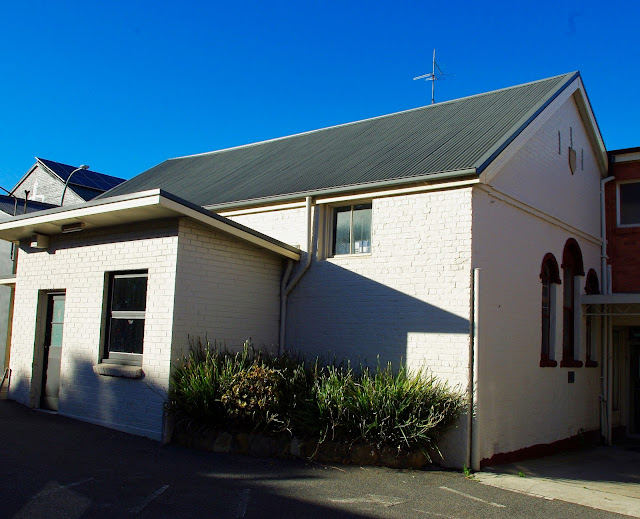
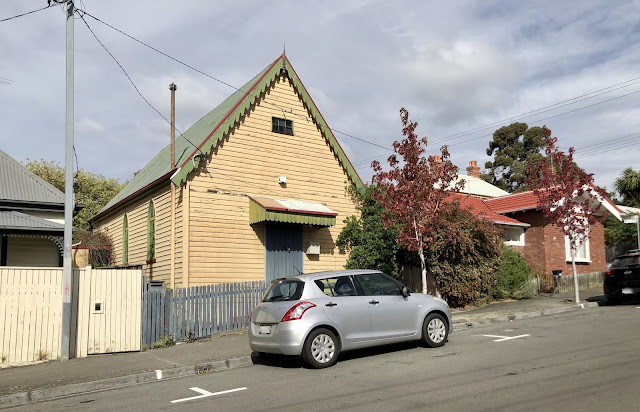
No. 988 - North Hobart - The "King Street" Church and School
Image
The suburb of North Hobart, as the same suggests, is on the northern fringe of the city. It has evolved into a mixed residential and commercial area since it was developed in the 1830s. Pitt Street, which runs southwest from Elizabeth Street, was called King Street until 1921 when it was changed to avoid confusion with another King Street in nearby Sandy Bay. The 'King Street' church and school were established by Reverend Isaac Hardcastle Palfreyman in 1883. The construction of the church was funded by Palfreyman while the school house was probably the same building as the King Street Baptist Sunday school which was established by the Sunday School Union in August 1871. The church and schoolhouse stood alongside each other but only the church remains. Isaac Palfreyman was an ordained minister of the Church of England who migrated to Victoria from Derbyshire in 1861 to become assistant pastor of the Primitive Methodist Mission at Ballarat. In 1872 he moved to Longford to take c...

No. 884 - Wivenhoe - Lifehouse Church

Image
Wivenhoe is a suburb of Burnie situated on the east bank of the Emu River. It has developed into an industrialised area less than 3 kilometres south-east of the city centre. In the 1850s the area was named after the town (and parish) of Wivenhoe in Essex County by Captain Henry Butler. The Lifehouse Church, which is located on Wivenhoe Main Road, describes itself as an independent church. It is associated with the Apostolic tradition which has had a presence at Burnie since the 1940s. The Apostolic Church in Australia is now known as the “Acts Global Churches” . The Apostolic Church is a denomination linked to the Pentecostal movement. The term "Apostolic" represents the denomination's belief that it follows the teachings of the twelve apostles who followed Christ. With roots in the 1904–1905 Welsh Revival, it seeks to revive first-century Christianity in its faith, practices, and government. Additional information about this church and the building is most welcome as al...

No. 839 - Devonport Community Church

Image
Devonport was created in 1890 with the merging of two towns on the opposite banks of the Mersey River; Formby on the west bank and Torquay on the east bank. The area was first settled in the 1840s. Over thirty places of worship have been established at Devonport since settlement began. The Devonport Community Church is a more recent addition being established in the 1990s. The church is located on Formby Road in a converted building which includes a Christian bookshop. The Devonport Community Church describes itself as a meeting place “for the worship of God, the preaching of the gospel, Christian fellowship and care, as well as being an outreach to those in need”. The church does not appear to be connected to any of recognised denominations but can be classified as an independent evangelical church. Additional information about this church and the building is most welcome as all articles are continually updated. I can be contacted through this page or my Facebook page "Churc...

No. 578 - Richmond - The Congregational Chapel (1845 - 1875) - "A Half Barn Place"

Image
Richmond is a heritage town located in the Coal River Valley approximately 25 kilometres east of Hobart. The valley was one of the earliest areas penetrated by the first British settlers outside of Hobart. The settlement began around 1823 when a bridge was constructed across the Coal River, so named because of coal deposits in the area. The 1830’s was a time of church building at Richmond with the historic St Luke’s Anglican church and a Catholic church, St John the Evangelist, both constructed during this decade. The Independent or Congregational community used Richmond’s Court House as a place of worship around this time. The first services were held by a visiting minister Reverend Joseph Beazley and later by Reverend Alexander Morison. In September 1844 Reverend Moses Parker was appointed the first permanent minister by the Congregational Mission Society. Following Reverend Parker’s appointment a chapel was built in Torrens Street on land donated by John Kestall Buscombe and was...

No. 393 - The Independent Church of Christ at Ulverstone

Image
The Ulverstone Independent Church of Christ is situated on Leven Street opposite Sacred Heart Catholic Church. Very little published or on-line information about the church is available. It was established in 1985 as a breakaway group from the Ulverstone Church of Christ and sees itself as a continuation of the original Church Christ established on South Road in 1905. The church’s website (now archived by the National Library), gives the reason for the schism as follows: “We separated ourselves from the denomination known as the Associated Churches of Christ. The reason for our separation was to stand on the authority of the Bible as the Word of God and to avoid being involved in support of apostasy, including support for the World Council of Churches”. The building was erected in 1956 as a Christian Reformed Church. It was used until 1974 when a larger Christian Reformed Church was built at 36 John Street. The Jehovah's Witnesses then used the building as a Kingdom Hall for a numb...

No. 132 - Latrobe Congregational Church - 'Bennett's Bad Luck'

Image
A Congregational church at Latrobe opened in April 1878 when a simple timber church was opened.  (1)   A report in The Examiner provides some detail about this building: “The place of worship just opened is a neat wooden structure situated in Hamilton Street between the Wesleyan and Episcopalian churches, and is capable of seating about 150 hearers. The site on which it is built is a corner allotment fronting in Hamilton and George streets. The first promoters hoped to build a more imposing brick structure, but failing this they have erected the present building, and it has been so nicely finished that it will serve the purposes of this body of Christians for some time, and will, it is hoped, at some future period serve the purposes of a Sunday school”. (2) At this time, the church did not have a permanent pastor but was awaiting the arrival of Reverend Bennett from America, “with whom a correspondence had been opened respecting the permanent pastorate of the Mersey churches”....

No. 77 - The Memorial Baptist Church - Reed's Temple

Image
This is one of the most visible churches in Launceston situated on Wellington Street, the busiest thoroughfare in the city. It is known for its quirky signboard on the street front with a clever turn of pun, forever attempting to attract potential customers. It is called the "Charcoal Chicken" church by some Launcestonians, in reference to an equally iconic business premises right on its boundary. This is the former Memorial Church named in honour of Henry Reed, founder of the city’s Christian Mission Church which now lies down an alley behind it. Reed was one of Tasmania’s leading businessmen as well as a banker and philanthropist besides being an ardent evangelist who made a significant contribution to the Christian cause in Australia and in Britain. Henry Reed was born in Doncaster, England in 1806. At the age of 20 he sailed for Hobart arriving in April 1827. From Hobart he walked to Launceston, a distance of 120 miles. Reed had a deep religious experience in the early...

No. 49 - The Wycliffe Chapel Vincent Street Launceston - A Chapel of Ease

Image
The Wycliffe Chapel is virtually invisible today. It is found in a narrow side street of Launceston and its front is a bicycle shop. Although only remnants of the original chapel are visible, it is nevertheless listed on the heritage register. The reason for this is because of its direct association with the Reverend Charles Price. “There remains little of physical worth with really only part of one facade visible. However, that the building still exists physically acknowledges the social importance of the Rev. Charles Price who amongst many other deeds, built the chapel at his personal expense for his Congregational ministry.” (1) The two other churches associated with Price, one in Tamar Street and the other at Inveresk, have long since vanished. The Vincent Street chapel was built in 1848 and is named after John Wycliffe (1320-1384) who first translated into English the Bible used by Independent Congregationalists and Primitive Methodists. It was built from private funds by Price ...