Posts

Showing posts with the label 1950-1959

No. 1013 - Glenorchy - St Andrew's Anglican Church (1958-1975)

Image
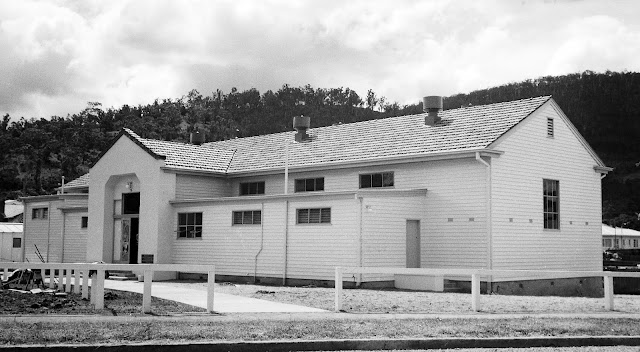
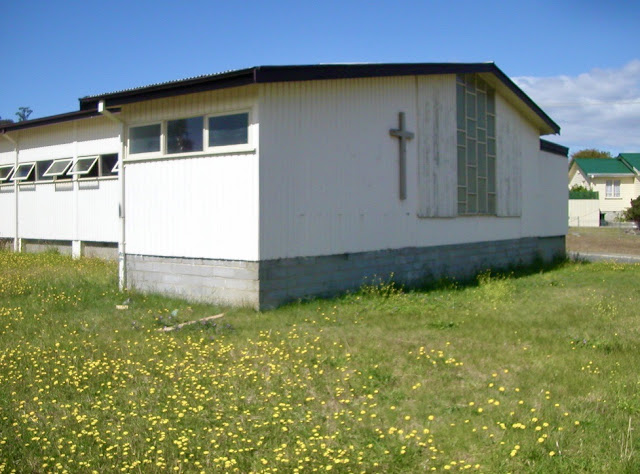
The city of Glenorchy is located approximately 7 kilometres north of Hobart's CBD. Glenorchy means ‘glen of tumbling waters’ and it is believed that Governor Lachlan Macquarie named the area after his wife’s birthplace; Glen Orchy, Argyllshire. St Andrew’s was built in 1958 and was opened and consecrated in the same year. The building was an old army hut from the Brighton Military Camp which was transported to Glenorchy and reassembled with some modification. As can be seen in the photograph, the church is constructed of rough hewn vertical board with a corrugated iron roof. The sanctuary and altar were built by Richard Lord. St Andrew’s was a short-lived church with religious services ceasing in the early 1970s. The site was sold and the building removed in 1975. St Andrew's at Glenorchy (1958) Source: Henslowe, Dorothea I. and Hurburgh, Isa.  Our heritage of Anglican churches in Tasmania / by Dorothea I. Henslowe ; sketches by Isa Hurburgh  [S.l  1978
No. 986 - Redpa - St John's Anglican Church

Image
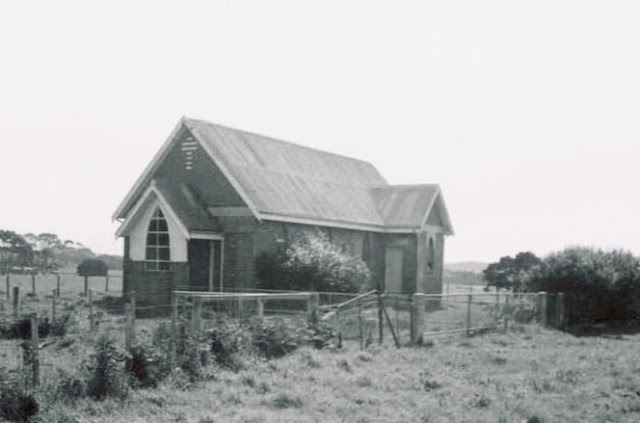
Redpa is a small settlement in the far northwest approximately 40 kilometres west of Smithton. It was originally named Marrawah East before it was changed to Redpa in 1926. The residents asked that it be renamed Braddon but “the authorities decided otherwise”. Redpa is an aboriginal word for "mosquito".  St John’s Anglican church was built and dedicated in 1955. It replaced an earlier Anglican church hall built in 1925 which had served as a church and a community hall. The foundation stone for St John's was laid on Sunday 24 April 1955 by the Venerable Archdeacon W. Walters. The land for the church was donated by Mr. L. Mortyn. Dorothea Henslowe records in ‘Our Heritage of Anglican Churches in Tasmania’, that in a font was purchased from the proceeds of a sale after each family in the congregation raised a pig. The final service was held on Sunday 31 August 1986, after which the congregation combined with St Oswald's at Marrawah. Additional information about this chur...

No. 975 - Smithton - Seventh-day Adventist Church

Image
Smithton is the commercial and industrial centre of the Circular Head district in the far northwest of the island. The early settlement was known as Duck River but this was changed to Smithton in 1895. Smithton is named after an Irishman, Peter Smith, who had been a constable, and later the licensee of ‘The Plough Inn,’ at Stanley. Smith moved to Duck River after buying some 500 acres of land from the Poke and Ollington families. Smith’s successful enterprises enabled his return to Ireland. The Seventh-day Adventist Church was established in Tasmania in 1888. The denomination originated in the USA in the 1860s and in 1885 a group of Adventists travelled to Australia and began preaching in Melbourne. After a community was formed in Melbourne in 1886, members moved on to Sydney, Adelaide and Hobart. Public tent meetings were held in Sandy Bay in 1888 which led to the establishment of a church at Collinsvale and then Hobart followed by Launceston in the early 20th century. Smithton’s Seve...

No. 957 - George Town - Baptist Church

Image
George Town is one of the oldest towns in Australia and is the second oldest town in Tasmania. It is therefore unusual that most of the town’s churches were only established after World War Two. The emergence of Launceston as the administrative centre of the North in the early years of the colony meant that George Town was destined to remain a backwater until more recent times. The construction of an aluminium smelter at nearby Bell Bay in the 1950s as well as the development of industry south of the town, accelerated George Town’s population growth in the post-war era. George Town’s Baptist Church is situated on Goulburn Street adjacent to St Andrew’s Uniting Church. The church was established in August 1958 and religious services were held in the Town Hall. A building site was subsequently purchased and a church hall was officially opened on 12 August 1961. An extension to the building was completed in 1990. Additional information about this church is welcomed as all articles are con...

No. 945 - Claremont - St Bernard's Catholic Church "Economy with Dignity"

Image
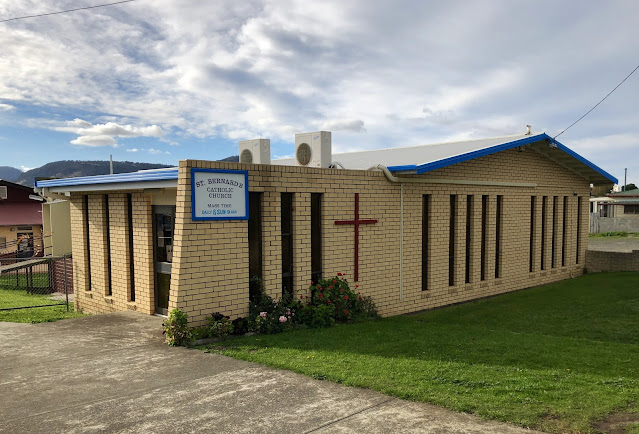
Claremont is a suburb of the City of Glenorchy within the Greater Hobart region. It is named after Claremont House built in the 1830s by Henry Bilton. Claremont was once the site of an army training camp established during the Great War. At this time the area had only a few scattered houses and a railway station in a largely rural setting. From the 1950s public housing was built at Claremont which resulted in significant population growth. Before a church was built at Claremont, Catholics went to Mass at Cadbury’s Hall and later in the local Memorial Hall. The rapid growth of the suburb after World War Two saw an influx of migrants which included a significant number of Polish and Croatian Catholics. St Bernard’s was officially opened and blessed by Archbishop Guilford Young on Sunday, 20 April 1958. Addressing the assembled parishioners, Archbishop Young remarked that the church represented “a fascinating combination of steel, timber and glass, which combined economy with dignity”. T...

No. 933 - Devonport - Parker Street Baptist Church Hall (1953-1988)

Image
Devonport was established in 1890 with the merging of two towns on the opposite banks of the Mersey River; Formby on the west bank and Torquay on the east bank. The area was first settled in the 1840s. The Park Street Baptist church Hall in West Devonport was built in 1953 to accomodate a Baptist Sunday school which had been previously held in a private home. The hall was built on donated land and constructed by voluntary labour. The official opening of the hall on Saturday 3 May is recorded in the Advocate: “Adherents of the Baptist Church from many parts of Tasmania attended the opening and dedication of the Baptist Church Hall in Parker St., Devonport, on Saturday afternoon. The function was performed by the general secretary of the Baptist Union in Tasmania (Rev. E. E. Watson). The opening ceremony and dedication were presided over by the minister of the Devon port Church (Rev. Max D. Brewer)…..Mr. Watson brought the greetings and congratulations of the Baptist Union. He declared t...

No. 916 - New Norfolk- St Columba's Presbyterian Church (1952) - The Church that Never Was.

Image
New Norfolk is a large town on the banks of the Derwent River approximately 40 kilometres west of Hobart. It is a historic town mostly settled by Norfolk Islanders soon after its establishment. When Governor Lachlan Macquarie visited the township he named it Elizabeth Town after his wife. However, it was later decided to adopt the name New Norfolk to acknowledge the new settlers. In Tasmania there are many examples of plans to build churches which were never realised. However, there are very few examples of a church being built but never used as a place of worship. The story of St Columba’s at New Norfolk is one of these and it needs to be told even though it is a virtual footnote in the rich history of the town’s many churches. Presbyterian services at New Norfolk date back to the 1870s although these were somewhat intermittent and ceased in 1876. By the mid 20th century progress towards building a Presbyterian church was finally realised. In October 1951 the Launceston Examiner repo...

No. 900 - Chigwell - St Monica's Catholic Church

Image
Chigwell is a suburb of Greater Hobart approximately 20 kilometres north of the city. It was developed by the Housing Department in the 1950s. It takes its name from "Chigwell House", the home of William Gore Elliston in the 1840s. In 1958 the Catholic parish of Claremont was created out of the larger Glenorchy parish which extended to Bridgewater. In the same year a block of land at Chigwell was purchased for £1250 to build a new church to serve the emerging suburb. Prior to the completion of St Monica’s, Maryvale, at nearby Collinsvale, was used for monthly Mass. By the end of the 1958 a simple vertical board and steel beam church designed by Architects Cooper and Vincent was completed. The church was officially opened on Sunday 21 December of that year. During the early years of the church the Missionary Sisters of Service were active in Chigwell, providing religious instruction for children. The Sisters stayed with local families and for a period in St Monica’s sacristy....

No. 887 - New Town - Exultation of the Holy Cross Russian-Serbian Orthodox Church

Image
New Town is a northern suburb of Hobart. It is also one of Hobart’s oldest suburbs and consequently the area contains many historic churches. New Town became a municipality in 1907 but was absorbed into Greater Hobart in the 1920s when its municipal status was relinquished. The Russian Orthodox Church on Augusta Road is the only parish church of the Russian Orthodox Church in Tasmania. It is also home to the Holy Cross Serbian Orthodox Mission. Construction of the church commenced in 1956 and was completed in 1963. The parish's first priest, the Very Reverend Archpriest Theodore Borishkevich, served from 1949 until his death in 1972. A curious feature of the church is a headstone placed near the entrance of the building. It is in memory of Gregory Belawin, Assistant Paymaster of the Russian Imperial Corvette, Boyarin, who died in May 1870. In 1870 the Boyarin visited at Hobart while on a voyage around the world. During the stay the crew were welcomed and entertained by the citize...

No. 881 - Ravenswood Gospel Chapel

Image
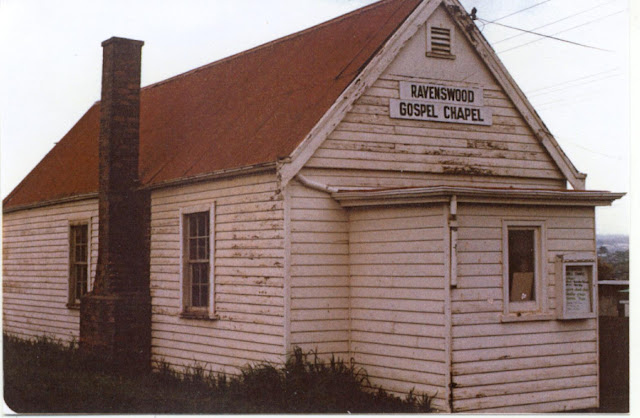
Ravenswood is a suburb north of Launceston which was one part of the former St Leonards Municipality. The suburb is named after the farmstead ‘Ravenswood’ which was established in the 1830s. The Ravenswood Gospel Chapel once stood near the intersection of Henry Street and Wildor Crescent before it was demolished in the 1970s. The chapel was originally the Ravenswood Christian Mission Hall, established by Henry Reed’s Christian Mission Church. The Mission opened in March 1883 and was built on land belonging to Robert Gibton. The Mission Hall operated for 25 years before it came under the control of the Baptists in either 1907 or 1908. A photograph published in the Weekly Courier (1909) shows the old Mission Hall opposite the Ravenwood Methodist Church adjacent to the old Ravenswood cemetery. The Baptist Mission fell under the authority of the Cimitiere Street Baptist Tabernacle. The Baptist’s used the hall until the late 1930s when it was closed for a period of time before reopening ...

No. 871 - Moonah - St Therese of Lisieux Catholic Church

Image
Moonah is a suburb of Greater Hobart and is located approximately 5 kilometres north of the central business district. Moonah was previously known as South Glenorchy before it was developed as a residential area in the late 19th century. The parish of St Therese, Moonah, was created in February 1931with Father T.J. O’Donnell appointed to oversee the construction of the new parish’s first place of worship. Previously Catholic Mass was celebrated in the Moonah Community Hall. On 25 October 1931 the foundation stone for a church-school was laid by the Very Rev. D. Murphy, Administrator of the Archdiocese of Hobart. Built in the midst of the Great Depression, the building had a threefold function; that of a church, a school and a hall. It is also unusual in that it housed a nuns’ chapel within the church as well as an enclosed shrine to Saint Therese. Moonah’s first Catholic church was designed to be a temporary place of worship until a permanent church could be constructed. However, t...

No. 857 - Chigwell - St Martin's Anglican Church (1959-2018)

Image
Chigwell is a northern suburb of Hobart approximately 20 kilometres from the city. It was built and named by the Housing Department in the 1950s. It takes its name from Chigwell House, the home of William Gore Elliston in the 1840s. In 1958 an old army hut was obtained from from Brighton Camp and converted into a church hall. The building had to be demolished because of asbestos sheeting in the roof. It was replaced by a new cement block church built on the same site at the Corner of Allunga Road and Junee Street. St Martin’s was one of 73 put up for sale in 2018 to raise funds for the Anglican Church’s portion of the National Redress Scheme for victims of child sexual abuse. The church was sold in 2020 and the building has since been substantially altered. Additional information about this church is most welcome as all articles are continually updated. I can be contacted through this page or my Facebook page "Churches of Tasmania" which is linked here: Churches of Tasmani...

No. 841 - Devonport Presbyterian Church

Image
Devonport was created in 1890 with the merging of two towns on the opposite banks of the Mersey River; Formby on the west bank and Torquay on the east bank. The area was first settled in the 1840s. By the 1950s Devonport’s original Presbyterian church, built in 1906, [ see No.232  ] was no longer able to accomodate the large congregation.  On 16 December 1956, the foundation stone for a new church, was officially laid by Rev. F.J. Scrimgeour, on a site adjacent to the earlier building,  The church was officially opened and dedicated, as St Columba’s, on 12 October 1957, by the State Moderator, the Rt. Rev. K. McLean. Situated on the corner of Best and Edward streets, the new church was built of brick with rendered interior walls and polished myrtle floors. The building was designed by architect Mr. A. A. Freak. The original communion table was retained but the pulpit and pews were replaced with modern pieces made of Tasmanian oak and maple. The new buildin...

No. 840 - Warrane - St Camillus Catholic Church (1959-2005)

Image
Warrane is an eastern shore suburb of Hobart established by the Housing Department in the late 1940s and early 1950s. Warrane is an Aboriginal word meaning 'blue sky’ and this was adopted for postal purposes for the Montague Bay area before it was transferred to its present locality in the 1940s. St Camillus is a short-lived Catholic church that was located at Amundsen Crescent. The church was sold in 2006 and has been substantially altered when it was converted into a house. St Camillus de Lellis was an Italian priest who founded the Camillians, a religious order dedicated to the care of the sick. He was beatified by Pope Benedict XIV in the year 1742, and canonised by him four years later. De Lellis is the patron saint of the sick, hospitals, nurses and physicians. Additional information about this church is most welcome as all articles are continually updated. I can be contacted through this page or my Facebook page "Churches of Tasmania" which is linked here: Church...

No. 824 - Rosny - The Church of Jesus Christ of Latter-day Saints

Image
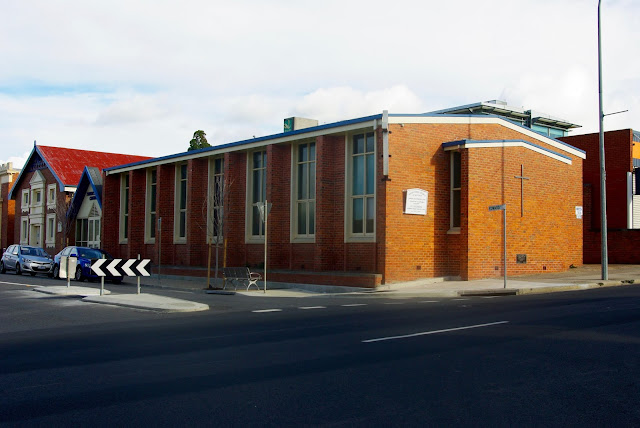
Rosny is an eastern suburb of Greater Hobart located on the banks of the Derwent River. The suburb spreads around the western slopes of Rosny Hill. The name is taken from Rosny Point, originally named Canadian Point. This was changed to Rosny after an ancestor of Walter Bethune, who was granted the land in 1820. The Church of Jesus Christ of Latter-day Saints (LDS) first appeared in Tasmania in the 1850s when missionaries began to proselytise in Hobart. Despite local opposition congregations were established in Hobart in 1894 and in the Upper Huon in 1899. The first chapel opened in 1924 at Lefroy Street, North Hobart, followed by a chapel built at Glen Huon in 1927. The 1950s was a time of growth for the LDS and the chapel at Rosny was the first to be constructed following the acquisition of nineteen sites across Tasmania for an ambitious building program. Prejudice towards the LDS by traditional churches, due to its unorthodox beliefs, presented a challenge when it came to purchasin...