Posts

Showing posts with the label 1850-1859

No. 1017 - Hobart - St Peter's Hall

Image
St Peter’s Hall is situated within St Mary’s Cathedral precinct at the corner of Harrington and Brisbane Street. The building originally stood on lower Collins Street before it was dismantled and reconstructed at its present site in 1904. St Peter’s Hall was built in 1855 as a temperance hall and school house as well as for occasional religious services. It is marked on Jarman’s 1858 map of Hobart where it is listed as a Catholic chapel. Two 19th century ‘birds-eye’ views of Hobart (see below) clearly show details of the building which was accessed by a footbridge across the Hobart rivulet. Lower Collins Street fell within a district known as Wapping, which was one of Hobart’s poorer quarters located close to the docks. This article draws from newspaper accounts from the 1850s which describe the halls construction and opening as well reports from 1904 concerning its removal and reconstruction near the cathedral. The Colonial Times records the laying of the foundation stone of St Peter’...
No. 1010 - New Norfolk - High Street Catholic Chapel (1850 - 1887)

Image
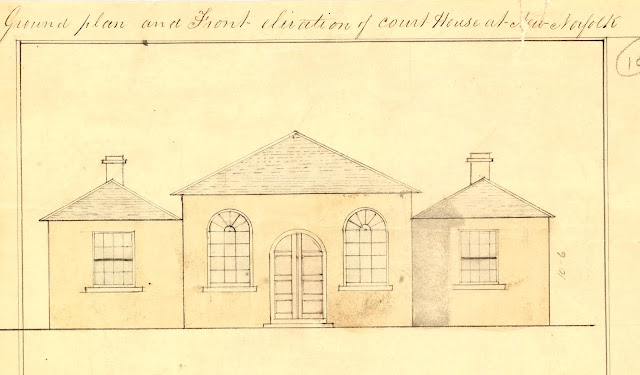
New Norfolk is a historic town on the banks of the Derwent River, approximately 40 kilometres west of Hobart. It grew dramatically when settlers from Norfolk Island moved into the district after 1807. When Governor Lachlan Macquarie visited the township he named it Elizabeth Town after his wife. However, it was later decided to adopt the name New Norfolk, acknowledging the district’s many Norfolk Islanders. The first Catholic Mass to be held in the township was held by Father Philip Connolly in 1821. In about 1850, New Norfolk’s police court house, located on High Street, was purchased by the Catholic Church for the sum of £450. The building was converted for use as a presbytery and the courtroom itself became the chapel. The earliest reference to the building’s use as Catholic chapel dates to January 1850 when the Colonial Times reported that the chapel was the venue for a subscription ball: “On Friday evening….the delightful town of New Norfolk was enlivened by the merry pipe and ta...

No. 1008 - West Hobart - St John the Baptist (1856-1998)

Image
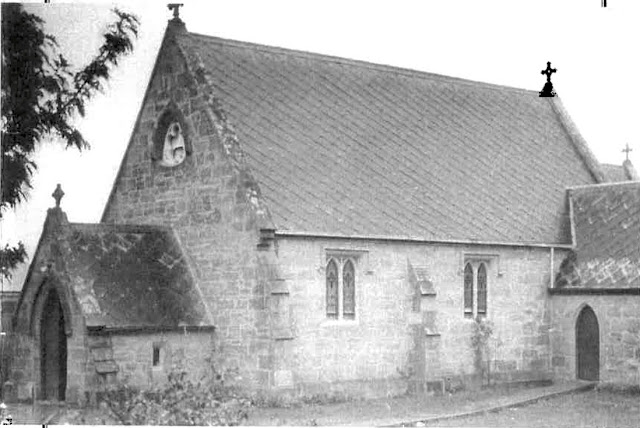
West Hobart is an inner-city suburb of Hobart immediately west of the city centre. The suburb occupies the high ground below Knocklofty Hill. The West Hobart parish was former in 1844 being carved from sections of St David’s and Holy Trinity parishes. The parish’s first church was built in 1845 [ see No. 992 ] and this building became a Sunday school following the opening of St John the Baptist in 1856. The ‘new’ church was built at a cost of £4300 and was designed by Frederick Thomas who modified the original plans drafted by George Edmund Street. Construction began in December 1852 and building was completed in three years. The church was consecrated by Bishop Francis Nixon in May 1856. In 1902 problems with the foundations which supported the chancel resulted in this section of the building being demolished and rebuilt. The rebuilt section was designed with additional height and included an organ chamber and a vestry. The church is built in the Gothic-Revival style. A window in t...

No. 994 - Old Beach Methodist Church (1853-2003)

Image
The settlement at Old Beach grew around a ferry service which ran from Austin's Ferry on the western shore of the Derwent River to a landing point on the eastern shore known as Compton Ferry. In 1824, the first settler to receive a grant in the area was John Ogle Gage. At the close of the 19th century Old Beach was described by correspondent for the Mercury: “Lying between Brighton Junction railway station and Risdon Ferry is the district of Old Beach, in which farming is the staple industry… habitation is scattered, and the public buildings are the Anglican and Methodist churches and the State school….”. While the establishment of St George’s Anglican church (1881) is well documented, the older Wesleyan Methodist church has left little trace in the historical record. The church opened in March 1853 and for about 20 years it was the only place of worship located in an area stretching from Pontville to Bellerive. By the 1870s the Anglican’s were using the church once a month by “the...

No. 990 - Hobart - St Mary's Cathedral (Part 1) - "The Wild Vines of Tasmania"

Image
The opening of Hobart’s St Mary’s Cathedral in 1881 brought an end to a 40 year saga that had begun in 1841 when an attempt was first made to build a new church at “Mount Carmel” on Harrington Street. This article traces the story of early efforts to build St Mary’s, Hobart’s third Catholic church and the city’s first Catholic cathedral. The appointment of Father John Joseph Therry as Vicar-General of Tasmania in 1839 resulted in the construction of St Joseph’s, the oldest Catholic Church in Hobart. Therry was an ambitious church builder but his incautious handling of finances became the cause of considerable controversy. This was to put a brake on Therry’s attempt to build a church on Harrington Street, previously the site of St Virgil’s Chapel, Tasmania’s first Catholic church. [ see No. 944 ]. A month before St Joseph’s was completed, construction began on St Mary’s with the ceremonial laying of the church’s foundation stone taking place on November 14, 1841. The ceremony was “one o...

No. 983 - Hollow Tree - Montacute - St James' Chapel

Image
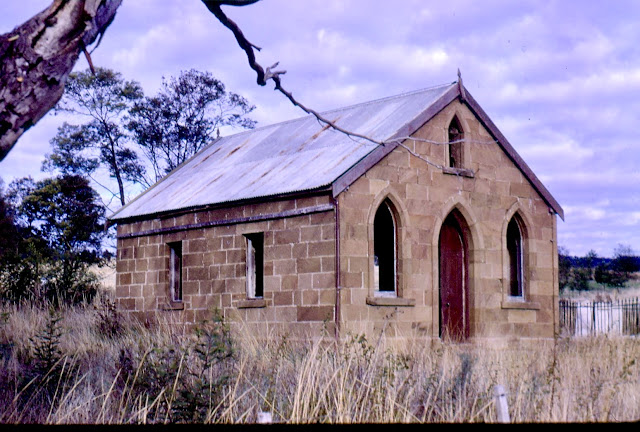
Montacute is an historic property in the Clyde Valley situated 14 kilometres south of Bothwell, on the Hollow Tree Road. This road was once the coach link between Hamilton and Bothwell. Montacute was was purchased by Captain William Langdon and added to his original land grant of 1823. In 1857 Langdon built a family chapel at Montacute. William Langdon was born in 1790 at Montacute vicarage, Somerset, England; the fifth son of Rev. William Langdon. He joined the Royal Navy at the age of 13 at the time of the Napoleonic wars. Following the Peace of Paris, Langdon retired from the navy and bought a merchant vessel, The Lusitania, and sailed to Sydney and Hobart Town, where he landed in 1821. Over the next few years Langdon acquired several more merchant ships. In 1823 Langdon received a grant of 1500 acres on the Clyde River to which he added another property which he named Montacute. In September 1834 Langdon settled in Van Diemen's Land with his wife and a daughter. Langdon is res...

No. 939 - Glenorchy - St John the Baptist Catholic Church (1859-1963)

Image
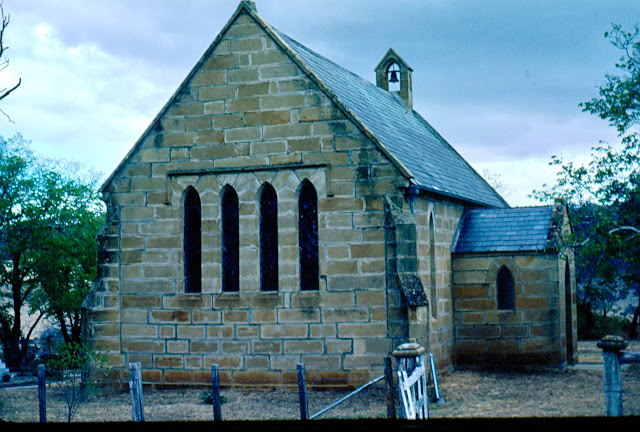
The city of Glenorchy is located approximately 7 kilometres north of Hobart's CBD. Glenorchy means ‘glen of tumbling waters’ and it is believed that Governor Lachlan Macquarie named the area after his wife’s birthplace; Glen Orchy, Argyllshire.The district was originally named 'King Georges Plains and the first centres of settlement were previously known as 'Kensington (Village)' and ‘O'Briens Bridge’. Before the 1840s, the district’s small Catholic community travelled to St Joseph’s church in Hobart to attend Mass. With the arrival of Bishop Willson in 1844, Mass was celebrated at the Glenorchy Probation Station. The early settlement was focused around O’Brien’s Bridge, and it was here, on the corner of Grove Road and Main Road, that the first Catholic church was built. The foundation stone for the church, was ceremonially laid on Tuesday 25 May 1858. The event was recorded in the Hobart Town Daily Mercury: “A most interesting ceremony took place at O'Brien...

No. 897 - Stanley Presbyterian Church

Image
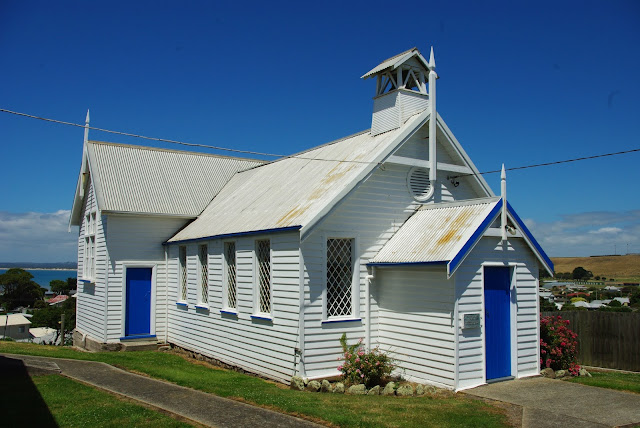
Stanley is a historic town on the far northwest coast approximately 80 kilometres west of Burnie. The Van Diemen's Land Company once had its headquarters in the area which was originally known as Circular Head. It was later named after Lord Stanley, the Secretary of State for the Colonies, who went on to serve three terms as British Prime Minister. Stanley’s Presbyterian church is one of the oldest churches on the North West coast. It is also unique in that it was the first prefabricated iron church imported to Tasmania. From 1853 Presbyterian services were regularly held in the Stanley police office. The first minister was Reverend James Garrett who periodically came from Launceston in a small boat. In late 1853 a meeting of subscribers decided to build a Church of Scotland at Stanley and “resolved to build an iron church if funds permitted”. At the following meeting in February 1854 instructions were given “in writing to Mr Gibson, who was about to visit England, to buy an iron...