Posts

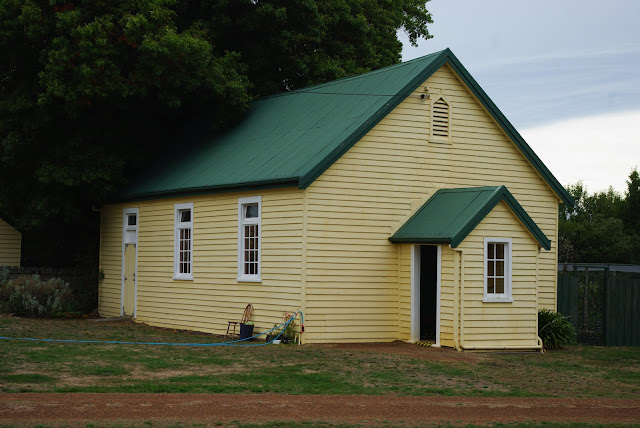
No. 1265 - Beauty Point - Methodist Church (1905-1914)

Image
This ‘blog entry’ is one of a series of articles about places of worship which are barely represented in the historical record. Usually no images of these buildings have survived. My hope is that these brief articles may result in further information and photographs coming to light enabling a more complete history to be preserved.  Beauty Point is a port town in the West Tamar region approximately 5 kilometres north of Beaconsfield. This was the first deep-water berth that was established on the Tamar River and it once serviced the goldfields at Beaconsfield. The settlement was previously known as Ilfracombe before it was changed to Beauty Point at the turn of the last century.  Beauty Point has had two Methodist churches, the first being built in 1905 followed by a second church in 1936.  The focus of this article is on the first church which functioned for less than a decade. In 1905 members of the small Methodist community approached the Department of Education with a ...

No. 1264 - Glenorchy - St Matthew's Sunday School Room (1850)

Image
This article is one of a series about buildings associated with Tasmania’s historical churches and religious orders.These buildings include Sunday schools, parish halls, convents, schools and residences of the clergy. Ancillary buildings are often overlooked and rarely feature in published histories. My aim is to create a basic record of these buildings, including buildings which no longer exist. When St Matthew’s Presbyterian church opened in November 1841, Glenorchy was known as O’ Brien’s Bridge, then a semi-rural area. In 1850 a Sunday school was built behind St Matthew’s church. In recent years the building has been the home of the Glenorchy History Room, run by the the Glenorchy Historical Society. The History Room has not been operational for a number of years. Little information about the Sunday school building’s origins are available in the public record. In November 1848 a fundraising Bazaar was held at the “Warerooms of Mr. L. Pearson, Cabinetmaker”, at Elizabeth Street in ...

No. 1263 - Evandale - St Andrew's Presbyterian Sunday School (1889)

Image
This article is one of a series about buildings associated with Tasmania’s historical churches and religious orders.These buildings include Sunday schools, parish halls, convents, schools and residences of the clergy. Ancillary buildings are often overlooked and rarely feature in published histories. My aim is to create a basic record of these buildings, including buildings which no longer exist. Evandale is an historic town approximately 20 kilometres from Launceston. Originally established as a military post in 1811, the general area was variously known as Collins Hill, Patersons Plains and Morven. The settlement’s name was changed to Evandale in 1836 in honour of Tasmania's first Surveyor-General, G.W. Evans. The foundation stone of St Andrew’s Presbyterian church was laid by the Governor, Sir John Franklin in 1838 and the building completed and dedicated in September 1840. A Sunday school hall was built in St Andrew’s church grounds in 1889 with the building officially opened o...

No. 1262 - St Helens - St Helena and St Stanislaw Catholic Church (1922)

Image
St Helens is the largest town on Tasmania’s east coast. It was a whaling station in the early 19th century and when tin was discovered in the hinterland in the 1870s, St Helens developed as a port for the mines. The focus of this article is on St Helens’ second Catholic church which replaced an earlier church. Records of the establishment of the first church are very patchy and the precise date of its construction is not known. [ see No. 1053 ] It was most likely built in 1871 for it is recorded that the foundation stone of the new church, laid in 1921, took place “50 years after the first church was built”. The original Catholic ‘chapel’ was a very rudimentary structure. Over the years numerous fundraising events were held to replace the building. In 1908 Hobart’s Daily Post reported: “ A bazaar in aid of the fund for the new Catholic Church here was opened at Thompson’s Hall by Mr H. Grant, who dwelt on the necessity of a new structure, and congratulated the congregation on possess...

No. 1261 - Marsh Paddock - Wesleyan Methodist Chapel and School (1855)

Image
This ‘blog entry’ is one of a series of articles about places of worship which are barely represented in the historical record. Usually no images of these buildings have survived. My hope is that these brief articles may result in further information and photographs coming to light enabling a more complete history to be preserved. Exton is a small village on the Bass Highway approximately 40 kilometres west of Launceston. When the area was first settled it was called Marsh Paddock. In 1856, the year after a church-school was built, a passing traveller described the village as follows: “Passing on from Westbury…to the Marsh Paddock, the property of of the Messrs. Field; in place of the old dilapidated building formerly used as a Government station, is now to be seen a large three-storey building, “The Marsh Paddock Inn”, the property of Mr. Motton, with a little village of settlers surrounding it. The rich nature of the soil still renders the road bad in the winter season, while two goo...

No. 1260 - Taroona - St Joseph's Child Care Centre (1970)

Image
This article is one of a series about buildings associated with Tasmania’s historical churches and religious orders.These buildings include Sunday schools, parish halls, convents, schools and residences of the clergy. Ancillary buildings are often overlooked and rarely feature in published histories. My aim is to create a basic record of these buildings, including buildings which no longer exist. Located on the Western shore of the Derwent River, Taroona is an outer southern suburb of Greater Hobart which lies within the Kingston municipality. The name ‘taroona’ is a Mouheneener word for chiton, a marine mollusc found on rocks in the intertidal regions of the foreshore. The name ‘Taroona’ was adopted by Clarendon James Cox Lord for his 18-acre property which he purchased in 1894. Information for this article is derived from the Taroona Historical Group’s publication ‘Taroona, 1808-1986 : farm lands to a garden suburb’. “On the 9th May 1969 the Sisters of Charity purchased Dr. J.A. Boot...

No. 1259 - George Town - St Mary Magdalene's Anglican Church (1841-1884) "An Architectural Deformity"

Image
George Town is the second oldest town in Tasmania. After the establishment of Launceston as the administrative centre of the north of the island, George Town was destined to become a backwater until more recent times. The focus of this article is on the second of four Anglican churches built at George Town. In 1804, a party of men led by Lieutenant Colonel William Paterson sailed into the mouth of the Tamar River where a cove on the eastern side of the river was selected as a temporary settlement. Paterson’s company had no ordained minister therefore he requested Edward Main, a former lay missionary, to read the first service. This event marks the first official religious ceremony in the north. The first Anglican minister at George Town was Reverend John Youl who conducted services in a small brick church that also served as a school. This was located on Cimitiere Street opposite Regent Square. After John Youl’s departure from George Town in 1824 there were difficulties in finding a r...

No. 1258 - Sandy Bay - St Peter's Parish Hall and Sunday School (1924)

Image
This article is one of a series about buildings associated with Tasmania’s historical churches.These buildings include Sunday schools, parish halls, convents, schools and residences of the clergy. Ancillary buildings are often overlooked and rarely feature in published histories. My aim is to create a basic record of these buildings, including buildings which no longer exist. Wellspring Anglican Church (previously St Peter’s) was established in 1917 when Mariners Church on Hobart’s Wharf was removed and rebuilt on Lord Street at Sandy Bay. A parish hall and Sunday school was built alongside the church in 1924. The Mercury reported on the ceremonial laying of the foundation of the new hall which took place on Saturday 9 August 1924: “…On Saturday afternoon The Bishop of Tasmania (Dr R S Hay)… laid the foundation stone of a building which is to serve a triple purpose in connection with St Peters Church, in Lord-street, the building being designed to serve as Sunday school, kindergarten, ...

No. 1257 - Sandy Bay - Baptist Church (1921)

Image
Sandy Bay is a southern suburb of Hobart. It is believed that it was named by Reverend Robert Knopwood while he was out on the Derwent on a whaling boat. The northern half of Sandy Bay was known as Queenborough between the years 1859 and 1878. A Baptist Mission was established at Sandy Bay in the late 1880s and land was purchased with the intention of building a church. However this did not progress and activities of the Mission came to an end. A revival of Baptist activity at Sandy Bay about 25 years later was more successful in 1921 the Baptists purchased St Matthias Anglican Hall on Sandy Bay Road. Originally known as the Queenborough Church Hall, the building was renamed St Matthias’ Church Hall in 1911. The hall was officially opened on Sunday 24th February 1889 by Reverend Canon G. Banks-Smith. The hall was also used as a public facility and it is likely that the Baptists used it before it was purchased from the Anglican Church in 1921. The hall was officially reopened as a Bapti...

No. 1256 - Pyengana - St Michael and All Angels' Anglican Church (1894)

Image
Pyengana is a dairy farming district approximately 30 kilometres west of St. Helens in Tasmania’s North East. The district was previously known as Upper George's River. Settlement began when George and Margaret Cotton established a property called St Columba in 1875. Before the 20th century Pyengana enjoyed significant growth as a result of tin mining activity. A butter factory was established in the 1890s followed by a cooperative cheese factory in 1902. Two churches were were established at Pyengana; a Catholic Church, St Augustine’s, which opened in 1923; and an Anglican church, St Michael and All Angel’s, which was established in1894. St Michaels and All Angels church was opened by Bishop Montgomery on Sunday 9 September 1894. The church was built at a cost of £65 under the direction of the rector of St Helens Parish, Reverend Owen Jackson. Later land surrounding the church was dedicated as a cemetery by Bishop Mercer. St Michael’s was one of 76 churches Anglican churches list...

No. 1255 - Kempton - St Peter's Catholic Church (1861-1918)

Image
Kempton is a small town on the Midlands Highway, about 45 kilometres north of Hobart. It was first settled by Anthony Fenn Kemp in 1817. He was given a grant of land, now the Mount Vernon estate. The town was first named Green Ponds after some small green water holes found in the area. The first Catholic church at built at ‘Green Ponds’ was a small timber building dedicated to St Peter. The church was opened and consecrated on Sunday 29 December 1861. It was intended to be a temporary church until a more substantial building could be constructed but it remained in use for more than half a century. It was located on Louisa Street alongside Kempton’s Catholic cemetery and approximately 200 metres west of a new church built in 1918. No photograph of the old church exists. In January 1962 the Hobart Advertiser carried a brief report describing the church’s opening service: “On Sunday, the 29th December, the Reverend Mr Keohan opened a new Catholic Church at Green Ponds, which was erected ...