No. 92 - Launceston - Sandhill - St Peter's Anglican Mission Hall (1924)
Sandhill is an area of Launceston which once extended from Melbourne Street to Gascoyne Street and west of Lawrence Vale Road. Parts of South Launceston and Glen Dhu were unofficially included within Sandhill.
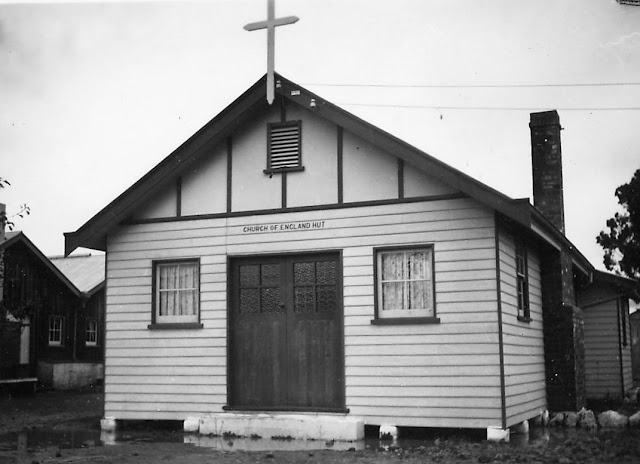
The hall adjoining the former St Mark’s Anglican church was Sandhill’s first Anglican church. It was used as a church for over 30 years until St Mark’s was built in 1961. Originally called St Paul’s Mission Hall, it was renamed St Peter’s church in 1934 to differentiate it from the ‘mother church’ located on Cleveland Street, South Launceston.
The ceremonial laying of the foundation stone for St Paul’s Mission Hall took place on Saturday 15 December 1923. The event was described in a report published in the Launceston Examiner:
“There was a very large attendance on Saturday at the Sandhill tram terminus for the laying of the foundation stone of the St. 'Paul's Mission Hall. The site is a block of land at the corner of the Hobart and Cleveland* roads where already the excavation has been completed and the foundations commenced by the contractor (Mr. Thomas Orr). The hall is to be a commodious building to serve Sunday school, church, and social purposes, and capable of enlargement. At 3 o'clock the Bishop of Tasmania (Right Rev. S. R.. Hay, D.D.), the clergy, and the surpliced choir of St. Paul's, together with the City Band…marched from the Sandhill tea rooms to the site…”.
The land for the Mission Hall was donated by the Cleveland family in the 1894 following the subdivision of the Normanstone Estate.
St Paul’s Mission Hall was designed by prominent Tasmanian architect, Hubert Springford East, who was responsible for many significant buildings in Launceston, including St Ailbe’s Hall and St Thomas More’s Hall. East also designed the tower of St Mary’s Church at Hagley and collaborated in designing Launceston’s landmark Holyman House.
St Paul's Mission Hall was officially opened by Archdeacon Beresford opened on Sunday 13 April 1924.
* The name ‘Normanstone Road’ was adopted in 1934, replacing the previous name, Cleveland Road, so as to avoid confusion with Cleveland Street in Launceston.
 |
| Photograph: Duncan Grant 2018 |
 |
| Photograph: Duncan Grant 2018 |
 |
| Photograph: Duncan Grant 2018 |
 |
| A photograph of St Mark's Mission Hall taken at the time of its opening. Photo: Weekly Courier, 14 April 1924 |
 |
| Photograph: Duncan Grant 2018 |
Sources:
Examiner, Monday 17 December 1923, page 5
Daily Telegraph, Monday 17 December 1923
Examiner, Monday 14 April 1924, page 5
Weekly Courier, 17 April 1924
Examiner, Saturday 15 December 1934, page 8
Examiner, Tuesday 15 December 1936, page 6
Geoffrey Stephens, The Anglican Church in Tasmania, 1992.
Holloway, Kerry E and St. Mark on the Hill (Launceston, Tas.) The light on the hill : a history of the Anglican Church in South Launceston, 1924-2010. St. Mark on the Hill, Launceston, Tas, 2010.

Comments
Post a Comment