No. 1642 - Sandy Bay - Queenborough Mortuary Chapel (1876-1936)
A mortuary chapel is a building typically located within a cemetery or crematorium. It is used to hold funeral services, memorial services, or to temporarily house a coffined body before burial or cremation. With the advent of commercial funeral chapels in the early 20th century, mortuary chapel’s became redundant. In Tasmania mortuary chapels were located at cemeteries such as Carr Villa (Launceston); Cornelian Bay (Hobart); Devonport General Cemetery and Queenborough Cemetery (Sandy Bay).
The closure of Hobart’s St. George's and St. David's burial-grounds in 1872, following the development of a new cemetery at Cornelian Bay, greatly inconvenienced the residents of Queenborough and Sandy Bay:
“…the closing of these places imposed upon them the necessity of having to go to Cornelian Bay, a distance of at least four or five miles. Two or three funerals in the depth of winter — through cold, rain, and mud — and the inhabitants were roused”.
In 1873 two Sandy Bay businessmen, George Luckman and Stephen Large, established the Queenborough Cemetery Company. The Company purchased land belonging to the late William Chaffey for £280. The property stretched from Sandy Bay Road and extended up to Nelson Road to where Churchill Avenue and the Hutchins School are now located. Only the upper portion of the 20 acre estate was developed into a cemetery.
Work began in mid 1873:
“Some £500 or £600 is to be spent on the ground, and there are some half-a-dozen men busily engaged in clearing it, forming roadways and pathways, &c…. The entrance from the main-road will be by large ornamental gates, and there will be another gate at the keeper's lodge at the entrance of the cemetery ground. In the centre of the ground there will be a reserve for a mortuary chapel, to be erected of weatherboard, from which the various denominational departments will radiate. The beds will be 20ft wide, and the paths 8ft., and of course each denomination will have its own portion….”.
Tenders for the construction of weatherboard mortuary chapel were advertised in November 1875 and the building was completed in the following year. It is not known when the chapel was first used but one of the earliest recorded accounts of a funeral service held in the building was that of Captain Edward Lucas, of the Tasmanian Steam Navigation Company, who died in July 1879.
While the chapel remained in use until the mid 1920s, by the1890s it was already apparent that the building was not being adequately maintained by the Queensborough Cemetery Company. In 1898 a correspondent writing to the Mercury, having recently attended a funeral, complained:
“I could not help noticing the poverty-stricken appearance of the buildings,…The entrance gates…are almost entirely guiltless of paint, while the chapel and caretakers residence have more the appearance of two dilapidated barns…”
Despite its neglect, the building remained in use for at least another 25 years. The last recorded funeral service held in the chapel took place in January 1926 for Mrs Sarah Lankester of Woodbridge.
Although in a dilapidated state, the chapel was still standing in1935 as was described by a visitor to Queenborough:
“Although a cemetery is not a very cheerful or edifying place for a Sunday afternoon walk, the old burial ground at Queenborough attracts many who are not personally interested or connected with those who lie buried there…. and it is rather pleasant to see freshly placed bowls of flowers on some of the graves of persons buried very many years ago…The graveyard presents a very picturesque appearance at the moment with the sere and yellow leaves of autumn on the trees and covering the age-old gravestones and earthy mounds. The tumbledown chapel, almost hidden in its copse of trees, is another interesting feature….”.
The neglect and the deterioration of the chapel mirrored the scandalous decline of the cemetery and the illegal burial practice of “disinterring bodies” and “burning of remains” for the purpose of reusing gravesites.
By 1913 the Queenborough Cemetery Company had run out of money. Unable to maintain the cemetery, the property lay derelict until the Hobart City Council purchased the site in 1915.
Following its acquisition, the Council built sports grounds on the lower portion of undeveloped land off Sandy Bay Road. The remainder of the cemetery was used until it was finally closed in 1934. The cemetery itself was eventually redeveloped in 1961 for the construction of The Hutchins School and associated sports grounds. The headstones of some of the dead were preserved in a memorial garden off Peel Street. Other headstones were removed to a dedicated area at the Cornelian Bay Cemetery in New Town.
In March 1936 a Tender was advertised for the “Removal of Chapel and Re-erection as a Pavilion on Queenborough Sports Oval”. The removal was successfully accomplished as is mentioned in a report in the Mercury in August 1938:
“The old chapel which formally graced the Queenborough cemetery was moved a couple of years ago to the Queenborough hockey ground and converted into a commodious and highly satisfactory pavilion. Hot showers…have been installed, lockers built in, and coat pegs provided….”.
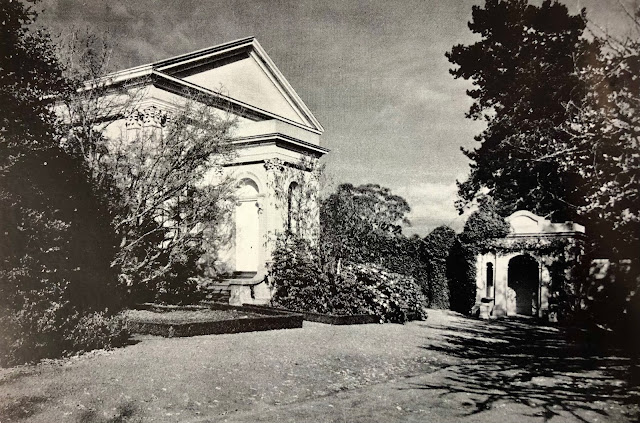
I have yet to find out how long the chapel was used as a pavilion and when the building was demolished or possibly removed from the site. I have been unable to find a photograph of the Chapel and only partial views of it exist in several photographs as the building was obscured by trees and headstones.
Queenborough Cemetery was back in the news in March 2024 with the discovery of human remains in two graves uncovered during initial excavation works at The Hutchins School as part of construction works for a new senior school campus. With construction halted the discovery of the remains almost 2,000 bodies were discovered. An archaeological team undertook what is believed to be the largest mass exhumation in Australian history. Links to reports and articles which detail this significant event are provided at the end of this page.
While the graves at Queenborough have finally been emptied, the cemetery holds memories of at least 3000 individual stories. Hopefully some of these stories will be told one day. I will highlight two stories which fascinate me: One is a Buddhist funeral held in 1902 and the second concerns the murder of 7 year old Eveline Mary Maughan.
A JAPANESE NAVAL FUNERAL:
In 1902 Hobart was visited by two naval ships from the Japanese Imperial fleet. The Mercury reported:
“The Japanese training ships Hiyei and Kongo, which anchored off the pilot station, Pearson’s Point... came up the point on Saturday morning, dropping anchor in the stream shortly before nine o’clock. They fired the customary [cannon] salute and the courtesy was returned from the Queens Battery. They left Yokosuka Harbour on February 19 and made calls at Manila, Thursday Island, Townsville and Melbourne, leaving the latter on the 7th Inst. ...The Captains of the vessels paid several visits, including one to the Governor, Sir Arthur Havelock. On Sunday a large number of the ships companies were ashore, visiting various parts of the city…".
During the visit, one of the ship’s company, a sailor named Kitani Jirozaemon, contracted meningitis and died aboard the Hiyei. The Mercury reported:
“Quite a thousand people assembled around Prince's steps, and the vicinity, on Wednesday morning, 14th instant, to witness the landing of the body of a Japanese sailor, Kitani Jirozaemon, who had died on board the warship Hiyei, and was buried at Queenborough Cemetery. Punctually at 10 o'clock, six of the ship's boats conveying the corpse, officers and cadets and crew, pulled slowly to shore, the company left in charge of the ship manning the sides until the funeral party had reached the shore. The procession was headed by an advance guard carrying long streaming banners, bearing Japanese inscriptions, and also carrying gold and silver artificial flowers, and the national flag Then came three buglers. The body was carried on a gun carriage, the usual firing party marching at the rear, and the ship's company following. The rear was brought up by carriages conveying the officers of the vessel and the cadets in, full uniform. Many of the former were gaily bedizened with medals and decorations. The body was enclosed in a coffin made aboard ship and was covered with a white cloth; then there was a draping of black cloth, with the Japanese flag on top. About 300 men and officers landed, bringing with them a gun carriage, upon which the coffin was conveyed to the burying ground.… Immediately following the corpse was the captain of the ship and a senior officer. The gun carriage and machine gun were drawn by 20 men. The procession proceeded to the cemetery by way of Montpelier Street, the buglers playing a Japanese naval march en route. On arrival at the cemetery the coffin was re-moved from the gun carriage and placed on two stands, and, in front, the flowers and edibles were put on a small table. Tapers were lighted, and the captain, after saluting, read a service in Japanese and a petty officer did the same. Officers and men afterwards saluted the coffin, and it was then removed to the grave. A salute was fired, and the edibles were thrown into the grave, which was then filled up. A post, with deceased's name inscribed thereon, was put at the head of the grave, and the banners were stuck in the newly turned soil, upon which was also left the table with the artificial flowers and other articles The ceremony was then concluded.”
A photograph Kitani Jirozaemon’s grave at Queenborough can be viewed below. The funeral and naval visit received significant news coverage as witnessed by the photographs published in The Tasmanian Mail. [see below]. In the 1960s the remains of the sailor’s body were removed to Cornelian Bay Cemetery. Kitani Jirozaemon’s name is recorded on plaque erected as a Memorial to the Naval Graves at Queenborough Cemetery.
2. EVELIN MARY MAUGHAN
Old cemeteries typically contain a significant number of graves and memorial stones dedicated to children, reflecting high mortality rates in an age before universal vaccination and other medical advances. Indeed, the first internment at Queenborough in 1873 was that of 8 year old Spencer Williams Grattidge, who died after “a long and painful illness”. Spencer’s remains were amongst those exhumed in in 2024.
The tragic story of Eveline Mary Maughan is very different from the hundred’s of children buried at the cemetery. On 8th July 1945, 7 year old Eveline disappeared after leaving her home at 100 Goulburn Street. On the 5th October, Edmund Mead of Goulburn, New South Wales, was visiting Queenborough Cemetery looking for his father's grave when he found a child's body in a lattice enclosure. It was identified as Eveline Maughan's. Her hands were tied in front of her and, because of the advanced state of decomposition, doctors were unable to state the cause of death. The evidence, however, was consistent with suffocation.
Suspicion fell on Frederick Thompson, whom witnesses claim to have seen carrying a heavy bath on his shoulder and later, wheeling a child's pusher in Nelson Road near the Queenborough Cemetery. Thompson appeared in the Supreme Court on the 11th December, 1945, charged with Evelin’s murder. He was sentenced to death and executed by hanging on the 14th February, 1946.
Thompson was the last person to be executed in Tasmania. Evelin’s body lies in an unmarked grave at Cornelian Bay Cemetery.
Sources and Links to further Information:
https://www.abc.net.au/news/2019-06-09/frederick-thompson-was-the-last-man-hanged-in-tasmania/11083304
The closure of Hobart’s St. George's and St. David's burial-grounds in 1872, following the development of a new cemetery at Cornelian Bay, greatly inconvenienced the residents of Queenborough and Sandy Bay:
“…the closing of these places imposed upon them the necessity of having to go to Cornelian Bay, a distance of at least four or five miles. Two or three funerals in the depth of winter — through cold, rain, and mud — and the inhabitants were roused”.
In 1873 two Sandy Bay businessmen, George Luckman and Stephen Large, established the Queenborough Cemetery Company. The Company purchased land belonging to the late William Chaffey for £280. The property stretched from Sandy Bay Road and extended up to Nelson Road to where Churchill Avenue and the Hutchins School are now located. Only the upper portion of the 20 acre estate was developed into a cemetery.
Work began in mid 1873:
“Some £500 or £600 is to be spent on the ground, and there are some half-a-dozen men busily engaged in clearing it, forming roadways and pathways, &c…. The entrance from the main-road will be by large ornamental gates, and there will be another gate at the keeper's lodge at the entrance of the cemetery ground. In the centre of the ground there will be a reserve for a mortuary chapel, to be erected of weatherboard, from which the various denominational departments will radiate. The beds will be 20ft wide, and the paths 8ft., and of course each denomination will have its own portion….”.
Tenders for the construction of weatherboard mortuary chapel were advertised in November 1875 and the building was completed in the following year. It is not known when the chapel was first used but one of the earliest recorded accounts of a funeral service held in the building was that of Captain Edward Lucas, of the Tasmanian Steam Navigation Company, who died in July 1879.
While the chapel remained in use until the mid 1920s, by the1890s it was already apparent that the building was not being adequately maintained by the Queensborough Cemetery Company. In 1898 a correspondent writing to the Mercury, having recently attended a funeral, complained:
“I could not help noticing the poverty-stricken appearance of the buildings,…The entrance gates…are almost entirely guiltless of paint, while the chapel and caretakers residence have more the appearance of two dilapidated barns…”
Despite its neglect, the building remained in use for at least another 25 years. The last recorded funeral service held in the chapel took place in January 1926 for Mrs Sarah Lankester of Woodbridge.
Although in a dilapidated state, the chapel was still standing in1935 as was described by a visitor to Queenborough:
“Although a cemetery is not a very cheerful or edifying place for a Sunday afternoon walk, the old burial ground at Queenborough attracts many who are not personally interested or connected with those who lie buried there…. and it is rather pleasant to see freshly placed bowls of flowers on some of the graves of persons buried very many years ago…The graveyard presents a very picturesque appearance at the moment with the sere and yellow leaves of autumn on the trees and covering the age-old gravestones and earthy mounds. The tumbledown chapel, almost hidden in its copse of trees, is another interesting feature….”.
The neglect and the deterioration of the chapel mirrored the scandalous decline of the cemetery and the illegal burial practice of “disinterring bodies” and “burning of remains” for the purpose of reusing gravesites.
By 1913 the Queenborough Cemetery Company had run out of money. Unable to maintain the cemetery, the property lay derelict until the Hobart City Council purchased the site in 1915.
Following its acquisition, the Council built sports grounds on the lower portion of undeveloped land off Sandy Bay Road. The remainder of the cemetery was used until it was finally closed in 1934. The cemetery itself was eventually redeveloped in 1961 for the construction of The Hutchins School and associated sports grounds. The headstones of some of the dead were preserved in a memorial garden off Peel Street. Other headstones were removed to a dedicated area at the Cornelian Bay Cemetery in New Town.
In March 1936 a Tender was advertised for the “Removal of Chapel and Re-erection as a Pavilion on Queenborough Sports Oval”. The removal was successfully accomplished as is mentioned in a report in the Mercury in August 1938:
“The old chapel which formally graced the Queenborough cemetery was moved a couple of years ago to the Queenborough hockey ground and converted into a commodious and highly satisfactory pavilion. Hot showers…have been installed, lockers built in, and coat pegs provided….”.
I have yet to find out how long the chapel was used as a pavilion and when the building was demolished or possibly removed from the site. I have been unable to find a photograph of the Chapel and only partial views of it exist in several photographs as the building was obscured by trees and headstones.
Queenborough Cemetery was back in the news in March 2024 with the discovery of human remains in two graves uncovered during initial excavation works at The Hutchins School as part of construction works for a new senior school campus. With construction halted the discovery of the remains almost 2,000 bodies were discovered. An archaeological team undertook what is believed to be the largest mass exhumation in Australian history. Links to reports and articles which detail this significant event are provided at the end of this page.
While the graves at Queenborough have finally been emptied, the cemetery holds memories of at least 3000 individual stories. Hopefully some of these stories will be told one day. I will highlight two stories which fascinate me: One is a Buddhist funeral held in 1902 and the second concerns the murder of 7 year old Eveline Mary Maughan.
A JAPANESE NAVAL FUNERAL:
In 1902 Hobart was visited by two naval ships from the Japanese Imperial fleet. The Mercury reported:
“The Japanese training ships Hiyei and Kongo, which anchored off the pilot station, Pearson’s Point... came up the point on Saturday morning, dropping anchor in the stream shortly before nine o’clock. They fired the customary [cannon] salute and the courtesy was returned from the Queens Battery. They left Yokosuka Harbour on February 19 and made calls at Manila, Thursday Island, Townsville and Melbourne, leaving the latter on the 7th Inst. ...The Captains of the vessels paid several visits, including one to the Governor, Sir Arthur Havelock. On Sunday a large number of the ships companies were ashore, visiting various parts of the city…".
During the visit, one of the ship’s company, a sailor named Kitani Jirozaemon, contracted meningitis and died aboard the Hiyei. The Mercury reported:
“Quite a thousand people assembled around Prince's steps, and the vicinity, on Wednesday morning, 14th instant, to witness the landing of the body of a Japanese sailor, Kitani Jirozaemon, who had died on board the warship Hiyei, and was buried at Queenborough Cemetery. Punctually at 10 o'clock, six of the ship's boats conveying the corpse, officers and cadets and crew, pulled slowly to shore, the company left in charge of the ship manning the sides until the funeral party had reached the shore. The procession was headed by an advance guard carrying long streaming banners, bearing Japanese inscriptions, and also carrying gold and silver artificial flowers, and the national flag Then came three buglers. The body was carried on a gun carriage, the usual firing party marching at the rear, and the ship's company following. The rear was brought up by carriages conveying the officers of the vessel and the cadets in, full uniform. Many of the former were gaily bedizened with medals and decorations. The body was enclosed in a coffin made aboard ship and was covered with a white cloth; then there was a draping of black cloth, with the Japanese flag on top. About 300 men and officers landed, bringing with them a gun carriage, upon which the coffin was conveyed to the burying ground.… Immediately following the corpse was the captain of the ship and a senior officer. The gun carriage and machine gun were drawn by 20 men. The procession proceeded to the cemetery by way of Montpelier Street, the buglers playing a Japanese naval march en route. On arrival at the cemetery the coffin was re-moved from the gun carriage and placed on two stands, and, in front, the flowers and edibles were put on a small table. Tapers were lighted, and the captain, after saluting, read a service in Japanese and a petty officer did the same. Officers and men afterwards saluted the coffin, and it was then removed to the grave. A salute was fired, and the edibles were thrown into the grave, which was then filled up. A post, with deceased's name inscribed thereon, was put at the head of the grave, and the banners were stuck in the newly turned soil, upon which was also left the table with the artificial flowers and other articles The ceremony was then concluded.”
A photograph Kitani Jirozaemon’s grave at Queenborough can be viewed below. The funeral and naval visit received significant news coverage as witnessed by the photographs published in The Tasmanian Mail. [see below]. In the 1960s the remains of the sailor’s body were removed to Cornelian Bay Cemetery. Kitani Jirozaemon’s name is recorded on plaque erected as a Memorial to the Naval Graves at Queenborough Cemetery.
2. EVELIN MARY MAUGHAN
Old cemeteries typically contain a significant number of graves and memorial stones dedicated to children, reflecting high mortality rates in an age before universal vaccination and other medical advances. Indeed, the first internment at Queenborough in 1873 was that of 8 year old Spencer Williams Grattidge, who died after “a long and painful illness”. Spencer’s remains were amongst those exhumed in in 2024.
The tragic story of Eveline Mary Maughan is very different from the hundred’s of children buried at the cemetery. On 8th July 1945, 7 year old Eveline disappeared after leaving her home at 100 Goulburn Street. On the 5th October, Edmund Mead of Goulburn, New South Wales, was visiting Queenborough Cemetery looking for his father's grave when he found a child's body in a lattice enclosure. It was identified as Eveline Maughan's. Her hands were tied in front of her and, because of the advanced state of decomposition, doctors were unable to state the cause of death. The evidence, however, was consistent with suffocation.
Suspicion fell on Frederick Thompson, whom witnesses claim to have seen carrying a heavy bath on his shoulder and later, wheeling a child's pusher in Nelson Road near the Queenborough Cemetery. Thompson appeared in the Supreme Court on the 11th December, 1945, charged with Evelin’s murder. He was sentenced to death and executed by hanging on the 14th February, 1946.
Thompson was the last person to be executed in Tasmania. Evelin’s body lies in an unmarked grave at Cornelian Bay Cemetery.
 |
| A glimpse of the Queenborough Mortuary Chapel which was surrounded by trees: Source: Libraries Tasmania - Photographer: A A Rollings |
 |
| Sandy Bay with the Queenborough Cemetery in the background - William James Little (W. J. Little) (Photographer) (NG526) - Libraries Tasmania |
 |
| Map showing the sections of the religious denominations and the Chapel Position. Tasmanian Archives: [Plan showing denominations within Cemetery] AB317/1/1 Register of Burial Plots in the Queenborough Cemetery |
 |
| The Tasmanian Tribune, Friday 19 November 1875 |
.jpg) |
| Queenborough Cemetery - graves of Joseph and Ellen Boden and John Hincks with Chapel in background / Photographer A A Rollings - Libraries Tasmania - Item Number: NS1553/1/629 |
 |
| The Queenborough Cemetery c.1886 , with views looking down the slope to to the River Derwent. The chapel is partly obscured by the plinth and obelisk in the foreground. Libraries Tasmania |
 |
| Thomas Biggs Clarke Memorial - Queenborough Cemetery - Libraries Tasmania - Item Number: NS1029/1/55 - Photographs and Negatives by R C Harvey (NS1029) |
 |
| Queenborough Memorial Garden - Findagrave (MargaretM) |
 |
| Queenborough Memorial Garden - Findagrave (MargaretM) |
 |
| The Mercury, Tuesday 17 March 1936 |
 | ||||
| Queenborough Cemetery - burial site of Japanese sailor Kitani Jirozaemon, showing Japanese banners Libraries Tasmania - NS5098/1/2 |
 |
| Kitani Jirozaemon’s funeral - The Tasmania Mail |
 |
| Memorial to the Naval Graves at Queenborough Cemetery - Findagrave.com (Minnie) |
 |
| Evelin Maughan - Advocate, Monday 13 August 1945 |
 |
| Examiner, Saturday 6 October 1945 |
Sources and Links to further Information:
The Mercury, Wednesday 3 September 1873, page 2
The Mercury, Tuesday 2 September 1873, page 1
The Tasmanian Tribune, Friday 19 November 1875, page 3
The Mercury, Friday 18 July1879, page 2
The Mercury, Tuesday 22 March 1898, page 4
The Mercury, Monday 12 May 1902, page 2
The Mercury, Wednesday 14 May 1902, page 2
Tasmanian Mail, 24 May 1902, page 20
The Mercury, Tuesday 14 January 1913, page 5
The Mercury, Saturday 18 January 1913, page 5
The Mercury, Monday 11 January 1926, page 1
The Mercury, Monday 27 May 1935, page 6
The Mercury, Tuesday 15 October 1935, page 5
The Mercury, Tuesday 15 October 1935, page 5
The Mercury, Tuesday 17 March 1936, page 11
The Mercury, Tuesday 16 August 1938, page
Advocate, Monday 13 August 1945, page 4
Examiner, Saturday 6 October 1945, page 1
REPORT ON EXHUMATIONS Former Queenborough Cemetery 71 Nelson Road
SANDY BAY TASMANIA, Brad Williams, Lauren Hanson-Viney, Bailey Williams, Jack Harry, Leah Ralph & Alan Townsend, May 2025
https://www.hutchins.tas.edu.au/assets/Former_Queenborough_Cemetery_Report_on_Exhumations.pdf
Links for further information:


Comments
Post a Comment