Posts

No. 1240 - Hobart - Holy Trinity Sunday School and Parish Hall
Image
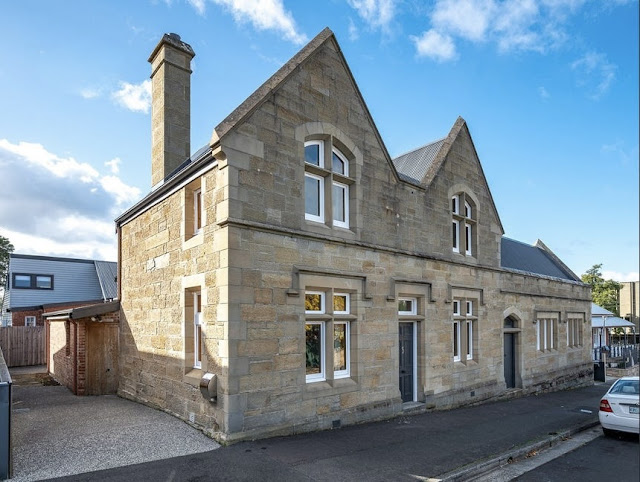
This article is one of a series about buildings associated with Tasmania’s historical churches.These buildings include Sunday schools, parish halls, convents, schools and residences of the clergy. Ancillary buildings are often overlooked and rarely feature in published histories. My aim is to create a simple record of these buildings, including those that no longer exist. Holy Trinity Anglican church was designed in the Gothic Revival style by James Blackburn. The church was built with the use of convict labour. The foundation stone was laid on Wednesday 20 October 1841 by Lieutenant-Governor Sir John Franklin. Holy Trinity Parish once had four Sunday schools including the Campbell Street school and the Church Street school below Holy Trinity church. Once a month children attended Holy Trinity for a service on Sunday afternoon. Each Sunday, there was two sessions of teaching held at the schools. A service was also held in the Church Street Parish Hall (which doubled as a classroom) for...

No. 1239 - Sandy Bay - Salvation Army Hall (1947)

Image
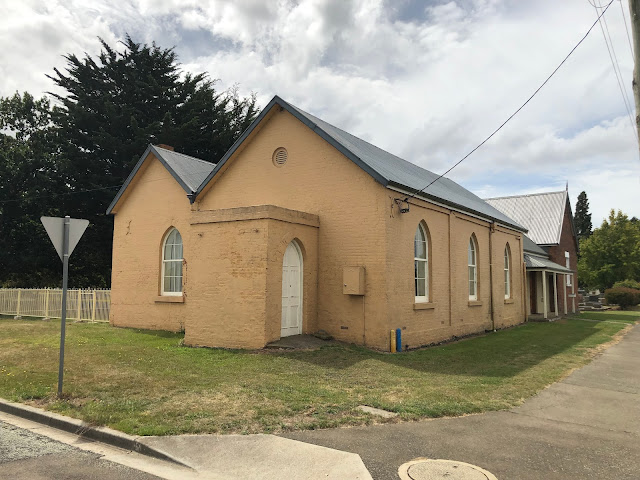
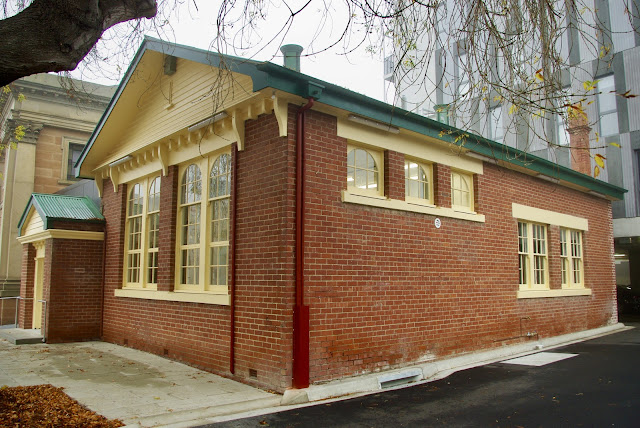
Sandy Bay is a southern suburb of Hobart. It is believed that it was given its name by the Reverend Robert Knopwood while he was out on the Derwent on a whaling excursion. The former Salvation Army hall is located in Lower Sandy Bay, previously known as Beachside. Sandy Bay’s Salvation Army hall was originally located at the tin-mining town of Derby in north eastern Tasmania where it was built in 1913. Following the catastrophic 1929 flood, Derby declined as a tin mining centre and the town’s population fell dramatically. By the early 1940s Salvation Army services ceased and the hall was closed. In 1946 the hall was taken apart and removed to Sandy Bay where it was reconstructed and reopened on Saturday 29 March 1947. The Mercury reported the official opening as follows: “Despite heavy rain a large crowd attended the official opening of the newly-erected Salvation Army hall at Lower Sandy Bay on Saturday. Brig. F. L. Inglis, the divisional commander, who performed the opening ceremon...

No. 1238 - Hobart - Baptist Church - Jack Soundy Memorial Hall

Image
This article is one of a series about the history of buildings associated with Tasmania’s historical churches. These buildings include Sunday schools, parish halls, convents, schools and residences of the clergy. Ancillary buildings are often overlooked and rarely feature in published histories. My aim is to create a simple record of these buildings, including those that no longer exist. The Jack Soundy Memorial Hall is located alongside Hobart Baptist Church on Elizabeth Street. “Jack” Soundy was the son of Sir John and Lady Soundy, a prominent Hobart businessman, politician and mayor of Hobart. He was deeply committed Christian and a member of the Hobart Baptist Church for over sixty years. John Trevor Soundy lost his life in January 1943 as co-pilot of a plane that went missing while delivering military supplies to Port Moresby in New Guinea. At the conclusion of the Second World War Jack’s friends decided to perpetuate his memory in some tangible way and a memorial fund was est...

No. 1237 - Longford - Christ Church Sunday School Hall (1845)

Image
This article is one of a series about the history of buildings associated with Tasmania’s historical churches. These buildings include Sunday schools, parish halls, convents, schools and residences of the clergy. Ancillary buildings are often overlooked and rarely feature in published histories. My aim is to create a simple record of these buildings, including those that no longer exist.Longford is an historical country town approximately 25 kilometres south of Launceston. The district around Longford was first known as the Norfolk Plains after the Norfolk Islanders who were resettled here in 1813. The settlement was called Latour before 1833 when it was renamed Longford. Longford’s historical Christ Church is the third Anglican church built at the town. The first church, built in the late 1820s, was no more than a temporary wooden hut which served as a place of worship until a more substantial church could be built. The second church, St Augustine’s, was used for less than a decade be...

No. 1236 - Battery Point - St George's Anglican Church (1838)

Image
Battery Point is an inner suburb on the east side of Hobart overlooking the Derwent River. Its name is derived from the Mulgrave Battery which was established in the 1818 as a coastal defence for Hobart. In the 19th century Battery Point was home to master mariners, shipwrights, seamen, fishermen, shipping agents and many others who worked in the shipbuilders’ yards and on the wharves. Until the mid 19th century much of Battery Point was undeveloped and without roads. A rough track ascended to Kermode's Hill, where St. George's Church now stands. St Georges is one of the most striking churches in Hobart and is a notable landmark. The church was built in stages with the tower and portico being later additions. St George’s was opened on Whitsunday, in June, 1838. Its origins date back to 1834 when a subscription list was opened for a building fund and a site was purchased for £250. The Hobart Town Courier described the site as having “a commanding eminence between the battery an...

No. 1235 - Battery Point - St George's Rectory (1896)

Image
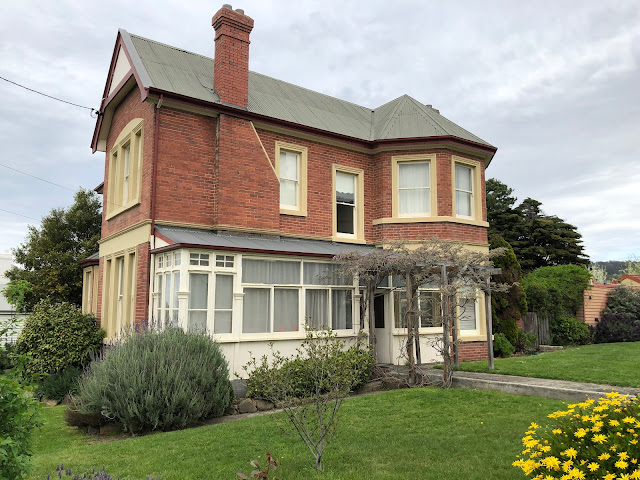
This article is one of a series about the history of buildings associated with Tasmania’s historical churches. These buildings include Sunday schools, parish halls, convents, schools and residences of the clergy. Ancillary buildings are often overlooked and rarely feature in published histories. My aim is to create a simple record of these buildings, including those that no longer exist. Battery Point is an historical inner suburb on the east side of Hobart, fronting onto the Derwent River. The suburb’s name is derived from Mulgrave Battery was established in the 1818 for coastal defence purposes. In the 19th century Battery Point was home to master mariners, shipwrights, seamen, fishermen, shipping agents and many others who worked in the shipbuilders’ yards and on the wharves. Until the mid 19th century much of Battery Point was undeveloped and without roads. A rough track ascended to Kermode's Hill, where St. George's Church now stands. St Georges is one of the most beautifu...

No. 1234 - Moonah - "Your Church"

Image
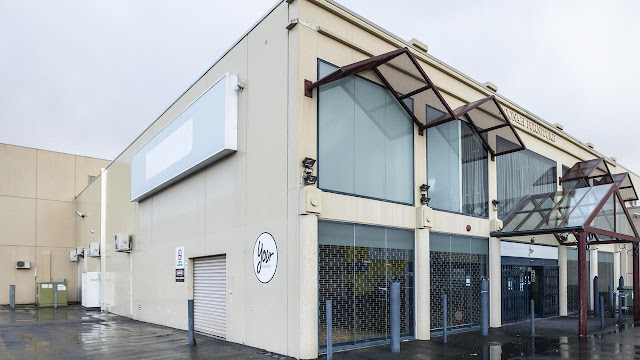
Moonah is a suburb of Greater Hobart approximately 5 kilometres north of the central business district. Moonah was previously known as South Glenorchy before it was developed as a residential area in the late 19th century. “Your Church” is the latest church to be established at Moonah. It was previously known as the “Energizer Life Church” which was located in Petchey Street, Bellerive. In 2019 the Energizer Life Church purchased the former Coogans store in Moonah with plans to redevelop the building into a community centre with an auditorium and space for retail tenancies. “Your Church” is a pentecostal denomination associated with Australian Christian Churches (ACC), previously known as the Assemblies of God in Australia. ACC is a network of Pentecostal churches affiliated with the World Assemblies of God Fellowship, the largest Pentecostal denomination in the world. "Your Church" in the former Coogans store at Moonah - photo: The Mercury The Energizer Life Church at Be...

No. 1233 - Launceston - The "Old Newnham Church of England" (1851-1887)

Image
Newnham is a northern suburb of the city of Launceston. Newnham was originally part of the municipality of Lilydale before it was incorporated into Launceston. Newnham was the name of a 250 acre property developed by Lieutenant Matthew Curling Friend in the 1830s. The first Anglican church at Newnham was opened on Sunday 4th May 1851 by Archdeacon Robert Davies. Little is known about this building which was located on George Town Road, opposite St Barnabas’ church. A booklet produced to celebrate the centenary* of St Barnabas, describes the old church as follows: “Just past the Alanvale Road turn-off one would see a brick and wooden building standing in in the tree lined hollow. This was known as the ‘Old Newnham Church of England’ and served the community as church and school. During the incumbency of the Rev. Augustus Barkway, before and up to 1859, services were held in this distant part of the Holy Trinity parish. On weekdays Mrs. and Miss Troy used the building as a school. Local ...

No. 1232 - Bridport - St Mark's Anglican Church - Sunday School

Image
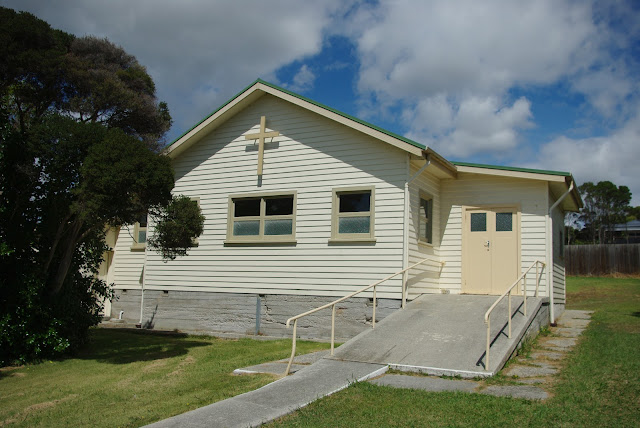
This article is one of a series about the history of buildings associated with some of Tasmania’s historical churches. These buildings include Sunday schools, parish halls, convents, schools and residences of the clergy. Ancillary buildings are often overlooked and rarely feature in published histories. My aim is to create a simple record of these buildings, including those that no longer exist. Bridport is a small resort town on Tasmania’s north-east coast situated at the mouth of the Brid River. It was once a significant port for hinterland mining settlements during the boom of the late 19th century. St Mark’s Anglican church was built in 1931 and was opened and dedicated by Bishop Hay on Sunday 19 July 1931. In the 1950s a Sunday school hall was erected behind the church. The church was sold in 2020 and has since been converted into business premises for the Little Rivers Brewing Company. In 2023 the Sunday school hall was to be demolished to make way for housing units. However, t...

No. 1231 - Hobart - Bishopscourt and the Montgomery Chapel

Image
Bishopscourt is the former official residence of the Anglican Bishop of Tasmania. It is located on Fitzroy Place at the northern tip of Sandy Bay. The property was sold by the Anglican Diocese in 2003. Part of the property is now used for accomodation and called ‘Old Bishop’s Quarters’. The land on which Bishopscourt stands was granted to William Anley in 1837. In the following year a substantial house was built, part of which was incorporated into later extensions. After it was build the house it was purchased by Thomas Horne, the properties first resident. Horne served as Solicitor General and later as Attorney General. He was also elected to the Legislative Council and held the office of President of the Council. In in 1858 the property was sold to William Robertson who in turn sold it to John White. White then rented the house to Bishop Bromby, the second Bishop of Tasmania. On taking residence Bromby named the property Bishopscourt. In 1876 Bishopscourt was purchased from John Wh...

No. 1230 - Legana - Regis Chapel

Image
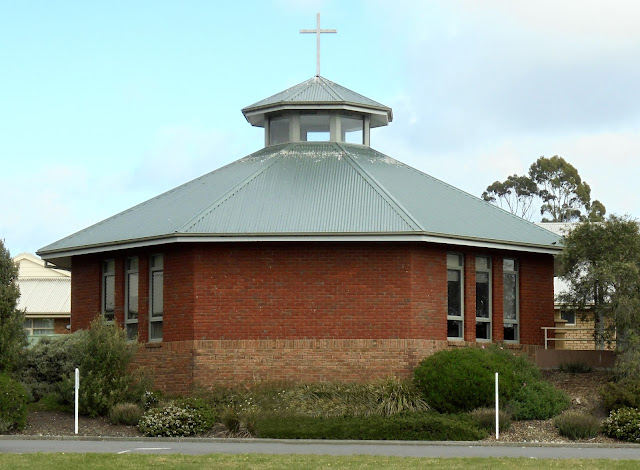
This is one of a series of brief articles which provide a simple record of chapels associated with institutions such as aged care facilities. Historically, most aged-care and nursing homes were established by religious denominations. Therefore most had a chapel built that was associated with the founding denomination. In more recent times few private aged care facilities continued the practice of providing non-denominational chapels for residents. Legana is a dormitory town 12 kilometres north of Launceston and situated within the West Tamar municipal area. Legana’s Regis aged-care home is owned by Regis Healthcare, one of the largest aged-care operators in Australia. The Legana home was originally established and operated by Presbyterian Care Tasmania. The Legana chapel is a modern brick octagonal shaped building with a raised turret situated in the centre of the roof. The chapel is non-denominational and served by the local clergy. https://www.regis.com.au/residence/regis-tasmania-l...