Posts

No. 1461 - Cranbrook - 'Gala Kirk' (1845)
Image
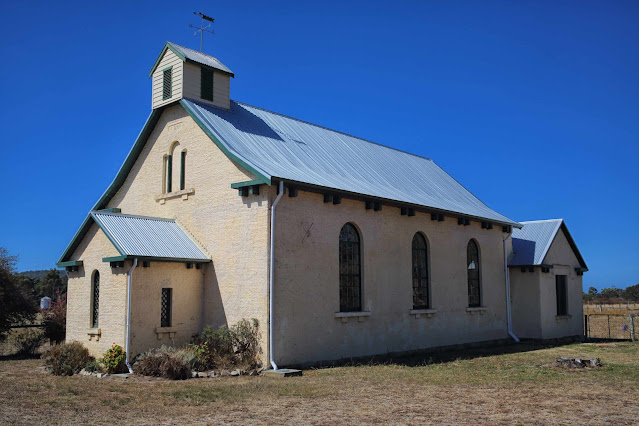
Cranbrook is a rural area located about 10 kilometres north of Swansea on the east coast of Tasmania. Gala Kirk is the oldest church on Tasmania’s East Coast and is closely associated with the Amos family. In 1884 a visitor passing through the area succinctly summarised the early history of the settlement: “There are several estates whose boundaries converge, and within a comparatively small area are several large homesteads - a church (Presbyterian), two cemeteries, a smith's shop, and a few workpeople's cottages. By reason of having a post office, it is called the town of Cranbrook…Cranbrook is then the nominal centre of four fairly large properties - Gala, Glen Gala, Glen Herriot, and Cranbrook… There is a wee house at Cranbrook, on the east of a basaltic hummock, called Cragie Knowe, which, being interpreted, meaneth "rocky hill." This part was settled on in the second decade of the [19th] century, or the first year of the third, by the Brothers Adam and John Amos...

No. 1460 - Richmond - St John's Catholic Schoolhouse (1843)

Image
This article is one of a series about buildings associated with Tasmania’s historical churches.These buildings include Sunday schools, parish halls, convents, schools and residences of the clergy. Ancillary buildings are often overlooked and rarely feature in published histories. My aim is to create a simple record of these buildings, including of those that no longer exist. Richmond is a heritage town located in the Coal River Valley approximately 25 kilometres east of Hobart. The valley was one of the earliest areas penetrated by the first British settlers outside of Hobart. Richmond’s origins go back to 1823 when a bridge was constructed across the Coal River. Beyond the bridge lies the church of St John the Evangelist, Australia’s oldest Catholic church along with Tasmania’s first Catholic school. The original school has survived and is located behind St John’s church. The origins of the school date back to 1843 and its founding recounted by Catholic church historian, Fr Terry Sout...

No. 1459 - Hobart - Murray Street - The 'Ebenezer Chapel' (1870)

Image
The United Free Methodist Church was formally established in Hobart on 11 December 1854*. Distinguishing features of the church were circuit autonomy and freedom to be represented in the Methodist Assembly by whichever minister or layman the congregation elected. Further congregations of the denomination were established at Wynyard, Burnie and Penguin. The ‘Free Church’ initially met in the rooms of the Upper Murray Street Infant School. In early 1855 plans were made to build a weatherboard church adjoining the Infant School. This building was officially opened on Sunday 7 October 1855. [ see No. 1440 ] In 1869 a new church designed by Edward Rowntree was built in front of the old Murray Street church. It was called the Ebenezer Chapel, from the Hebrew ebhen hā-ʽezer, meaning “stone of help”; a reference from the Book of Samuel where a stone was set up in commemoration of God's help to the Israelites in their victory over the Philistines. The foundation stone for the new “chapel” w...

No. 1458 - Mengha - Presbyterian Church

Image
This article is one in a series about public buildings in country areas that were used as places of worship. In these communities churches may have been planned but were never built due to lack of finance or changing circumstances. In most settlements, before a church was built, worship was typically held in homes, schoolrooms, barns, halls and other buildings. Conversely, in some communities, churches were sometimes the first public building erected and were used as schools and community halls. The focus of this series will primarily be on the public halls and schools that were used as churches. These buildings, and the religious communities which used them, are often overlooked in published histories of churches. Mengha is rural farming district on the northwest coast and lies south of the Stanley. The original name of the area was “Medwin” but this was changed to Mengha in 1905. The Medwin’s were pioneering family who opened up the district of South Forest during the 1840s. A Presby...

No. 1457 - Franklin - St Mary's Catholic Church (1856-2013)

Image
Franklin is a small town on the Huon Highway approximately 45 kilometres south of Hobart. It was established in 1804 and was the first settlement in the Huon district. It was named after the Governor of Tasmania, Sir John Franklin. Until the 1930s Franklin was a major town in the Huon Valley with its own court house, several hotels, a public hall and four churches. St Mary’s church is one of the oldest Catholic churches in the Huon Valley and served a sizeable population of Irish Catholics in the district. Many were of convict descent and the Catholic Church saw it as its mission to bring about “moral improvement” in a desperately poor community plagued by crime and drunkenness. Catholic church historian, Fr Terry Southerwood, recounts a letter written by Jane Therry, to her priest-brother, describing the opening of St Mary’s church in November 1856: “Jane first reported that the day was not propitious when Bishop Willson, Father Hall, Father Hunter and “several other clergyman and me...

No. 1456 - Hobart - St Peter's Hall (1904)

Image
This article is one of a series about buildings associated with Tasmania’s historical churches.These buildings include Sunday schools, parish halls, convents, schools and residences of the clergy. Ancillary buildings are often overlooked and rarely feature in published histories. My aim is to create a simple record of these buildings, including of those that no longer exist. St Peter’s Hall is located on the corner of Harrington Street and Brisbane Street Street and falls within St Mary’s Cathedral precinct. The building originally stood on lower Collins Street before it was dismantled and reconstructed at its present site in 1904. St Peter’s Hall was built in 1855 as a Catholic temperance hall and school house as well as for occasional religious services. It was designed by convict architect Frederick Thomas and built by John Gillon and Henry Shaw under the direction of Henry Hunter. The hall’s removal and reconstruction was completed by early 1904 and it was officially reopened on Su...

No. 1455 - Bruny Island - Variety Bay - St Peter's Anglican Church (1846)

Image
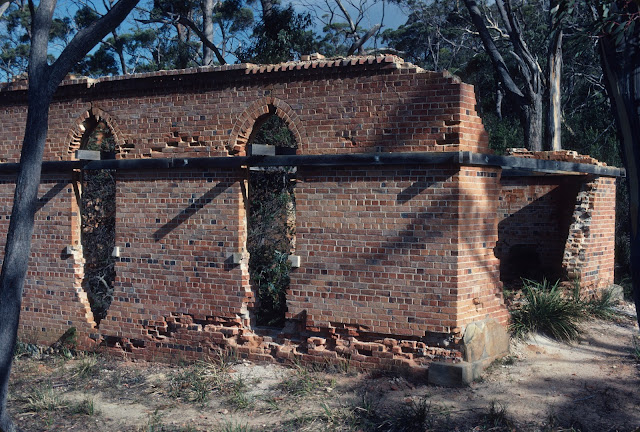
Variety Bay is located on North Bruny Island which lies off the southeastern coast of Tasmania. In 1831 a pilot station was established at Variety Bay to direct shipping into Hobart. Convict labour was used to build the station as well as a church that was constructed in 1846. The ruins of St Peter’s, which was the first Anglican church built south of Hobart, are situated about 1500 metres south of the station. St Peter’s church has a strong link with Bishop Francis Russell Nixon, the first Anglican Bishop of Tasmania, and Captain William Laurence, the pilot at the Variety Bay station. The church was constructed as a consequence of a meeting between Lawrence and Nixon upon the Bishop’s arrival in Van Diemen’s Land in July 1843. Three years later, when Nixon was about to depart Van Diemen’s Land for England on official business, he recalled his encounter with Lawrence who had piloted the ship ‘Duke of Roxburgh’ into Hobart: “…I must go to the first day of my arrival in the colony, and t...

No. 1454 - Longford - Methodist Sunday School (1902)

Image
This article is one of a series about buildings associated with Tasmania’s historical churches.These buildings include Sunday schools, parish halls, convents, schools and residences of the clergy. Ancillary buildings are often overlooked and rarely feature in published histories. My aim is to create a simple record of these buildings, including of those that no longer exist. Longford is an historical country town approximately 25 kilometres south of Launceston. The district around Longford was first known as the Norfolk Plains after the Norfolk Islanders who were resettled here in 1813. The Wesleyan-Methodist activity at Longford began in 1834 under the guidance of Reverend John Manton of Launceston. In 1836 the first chapel was built on Wellington Street on land donated by Joseph Heazlewood. Due to faulty foundations the building became unstable and was deemed too expensive to repair. In 1880 a new church was built on High Street while the Wellington street building was used as a Sund...