No. 1665 - Hobart - St John's Presbyterian Church (1843)
St John’s Presbyterian church was the third Presbyterian church built at Hobart. The first church, which opened in 1824, still exists and is located behind the Scots Memorial Uniting Church (then called St Andrew’s) on Bathurst Street. [See No. 1524] By the time St Andrew’s opened in 1837 it was already evident that the building would not be large enough to accomodate the Presbyterian community. The fact that three Presbyterian churches were built within the space of 20 years is testimony to Hobart’s Scottish community, who, while not the largest group numerically, exerted a vastly disproportionate level of influence over the colony's economy, architecture, media, and civic institutions.
The arrival of Scottish free settlers established a strong Presbyterian foothold in the colony. In 1822, the Reverend Archibald Macarthur arrived in Hobart as the first ordained Presbyterian minister. Macarthur was replaced by Rev. Dr John Lillie, (1837–1854) who is widely regarded as the most influential Presbyterian leader in the 19th century. In 1843 Reverend James Bell (1843–1852) arrived in Hobart to take charge of the newly established St John's Presbyterian Church on Macquarie Street.
The story of the Macquarie Street church began in 1840 when a building committee was formed with former convict, architect James Thompson, as chairman. The Scottish-trained decorative painter-cum-architect, engineer, and surveyor-builder, designed a church in the style of a Greek temple. Alexander’s design was produced around the same time that Lady Jane Franklin commissioned a classical temple, named Ancanthe, which she intended to serve as a museum for Hobart. Franklin was a keen follower of Grecian art and had a collection of drawings and pictures of temples. One might speculate that Lady Franklin may have either influenced or inspired Thomson to adopt a Grecian design for the new church.
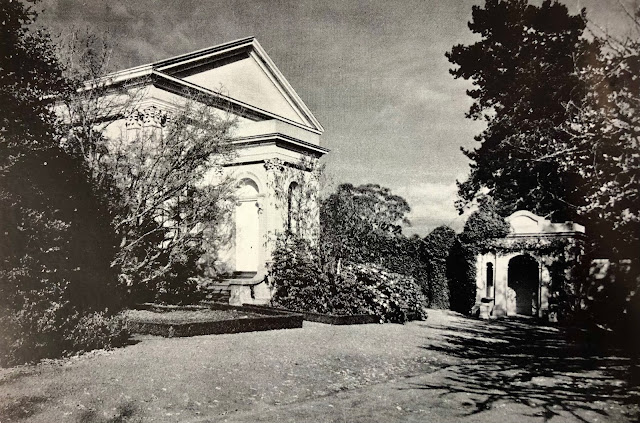
The church was built of sandstone and featured a large triangular pediment spanning the front. A gable roof extended the length of the building and into a hall at the rear. In the pediment, provision was made for a clock, as evidenced by an empty circular recess. The entrance to the church is framed by two Doric columns which are appropriately fluted and detailed.
The official opening of the church took place on Sunday 9 April 1843. The event received little attention in the Hobart press. The Colonial Times reported:
“The new Presbyterian Church in Macquarie-street was opened last Sunday, when eloquent discourses were delivered by Rev. Mr Lillie in the forenoon, the Rev. Mr Simson in the afternoon, and the Rev. Mr. Bell in the evening to most respectable and crowded congregations…We were agreeably surprised at the neat handsome manner in which the church is finished, it reflects great credit upon all concerned in the undertaking”.
In 1849 a manse was built behind the church, fronting on Davey Street. It is named ‘Bellkirk’, a play on the Gaelic word for church and Reverend James Bell, the minister for whom the manse was built. It is built in the Late Georgian style and possibly designed by Alexander Dawson. Not long after Reverend Bell moved into the Manse he became seriously ill and passed away at his new home in September 1852.
Following Reverend Bell’s death, services were conducted for a time by Mr. A. Cairnduff, a call then being given to and accepted by Reverend Robert Mcclean, who was inducted in 1853. In
1866 Reverend James Service was appointed. When he retired in 1870, returning to Glasgow, he was replaced Reverend James Scott. Under Scott the parish aggressively expanded its Sunday School network, establishing branches and services across the broader area (including nearby Sandy Bay) to accommodate hundreds of local children.
In the late 1870s St John’s briefly amalgamated with St Andrew’s Presbyterian church before resuming independent services in 1886 under Reverend I. K. McIntyre.
In the 1970s, with the establishment of the Uniting Church, St John’s congregation elected to remain a Presbyterian church, thus splitting from it sister church, St Andrew’s, which joined the Uniting Church and was renamed the Scots Memorial Church.


Sources and Further Information:
Colonial Times, Tuesday 4 April 1843, page 1
Colonial Times, Tuesday 11 April 1843, page 3
Mercury, Friday 12 April 1918, page 6
Mercury, Monday 3 April 1933, page 3
Mercury, Monday 5 April 1943, page 7
Stuart King, Scottish Networks and their Buildings in Van Diemen’s Land and Tasmania , ABE Journal [En ligne], 14-15 | 2019.
Booklet: St. John's Presbyterian Church, Hobart : 90th anniversary services (1930)
https://www.stjohnshobart.com/
https://www.facebook.com/stjohnshobart/
The arrival of Scottish free settlers established a strong Presbyterian foothold in the colony. In 1822, the Reverend Archibald Macarthur arrived in Hobart as the first ordained Presbyterian minister. Macarthur was replaced by Rev. Dr John Lillie, (1837–1854) who is widely regarded as the most influential Presbyterian leader in the 19th century. In 1843 Reverend James Bell (1843–1852) arrived in Hobart to take charge of the newly established St John's Presbyterian Church on Macquarie Street.
The story of the Macquarie Street church began in 1840 when a building committee was formed with former convict, architect James Thompson, as chairman. The Scottish-trained decorative painter-cum-architect, engineer, and surveyor-builder, designed a church in the style of a Greek temple. Alexander’s design was produced around the same time that Lady Jane Franklin commissioned a classical temple, named Ancanthe, which she intended to serve as a museum for Hobart. Franklin was a keen follower of Grecian art and had a collection of drawings and pictures of temples. One might speculate that Lady Franklin may have either influenced or inspired Thomson to adopt a Grecian design for the new church.
The church was built of sandstone and featured a large triangular pediment spanning the front. A gable roof extended the length of the building and into a hall at the rear. In the pediment, provision was made for a clock, as evidenced by an empty circular recess. The entrance to the church is framed by two Doric columns which are appropriately fluted and detailed.
The official opening of the church took place on Sunday 9 April 1843. The event received little attention in the Hobart press. The Colonial Times reported:
“The new Presbyterian Church in Macquarie-street was opened last Sunday, when eloquent discourses were delivered by Rev. Mr Lillie in the forenoon, the Rev. Mr Simson in the afternoon, and the Rev. Mr. Bell in the evening to most respectable and crowded congregations…We were agreeably surprised at the neat handsome manner in which the church is finished, it reflects great credit upon all concerned in the undertaking”.
In 1849 a manse was built behind the church, fronting on Davey Street. It is named ‘Bellkirk’, a play on the Gaelic word for church and Reverend James Bell, the minister for whom the manse was built. It is built in the Late Georgian style and possibly designed by Alexander Dawson. Not long after Reverend Bell moved into the Manse he became seriously ill and passed away at his new home in September 1852.
Following Reverend Bell’s death, services were conducted for a time by Mr. A. Cairnduff, a call then being given to and accepted by Reverend Robert Mcclean, who was inducted in 1853. In
1866 Reverend James Service was appointed. When he retired in 1870, returning to Glasgow, he was replaced Reverend James Scott. Under Scott the parish aggressively expanded its Sunday School network, establishing branches and services across the broader area (including nearby Sandy Bay) to accommodate hundreds of local children.
In the late 1870s St John’s briefly amalgamated with St Andrew’s Presbyterian church before resuming independent services in 1886 under Reverend I. K. McIntyre.
In the 1970s, with the establishment of the Uniting Church, St John’s congregation elected to remain a Presbyterian church, thus splitting from it sister church, St Andrew’s, which joined the Uniting Church and was renamed the Scots Memorial Church.

 |
| Photograph : St John's Facebook page |


 |
| Colonial Times, April 1843 |
 |
| St. John's Presbyterian Church, Hobart : 90th anniversary services booklet |
Sources and Further Information:
Colonial Times, Tuesday 4 April 1843, page 1
Colonial Times, Tuesday 11 April 1843, page 3
Mercury, Friday 12 April 1918, page 6
Mercury, Monday 3 April 1933, page 3
Mercury, Monday 5 April 1943, page 7
Stuart King, Scottish Networks and their Buildings in Van Diemen’s Land and Tasmania , ABE Journal [En ligne], 14-15 | 2019.
Booklet: St. John's Presbyterian Church, Hobart : 90th anniversary services (1930)
https://www.stjohnshobart.com/
https://www.facebook.com/stjohnshobart/


Comments
Post a Comment