Posts

No. 1205 - Hobart - All Saints' Anglican Church (1859) - "A perfect specimen of architecture"

Image
The landmark All Saints Anglican church on Macquarie Street, South Hobart, is the second church built on this site. Following the creation of the All Saints parish in 1855, a ‘temporary church’, known as ‘All Saints chapel’, was erected as a place of worship until a permanent church could be built. [ see No. 575 ] In 1858 construction began on a new church. It was of an early English Gothic design by architect Henry Hunter. The building’s foundation stone was ceremonially laid on Thursday 2 December 1858: “The ceremony of laying the first stone of the Church proposed to be erected in the Upper part of Macquarie-street took place, as announced in the Courier of yesterday, at three o'clock in the afternoon. The ceremony was performed by His Excellency the Governor, attended by the Lord Bishop of Tasmania, in the presence of a large number of ladies and gentlemen, ….The parish of All Saints, which was formerly included in St. George's parish, is fast increasing in population, par...
No. 1204 - Launceston - Frederick Street Chapel (1839-1842)

Image
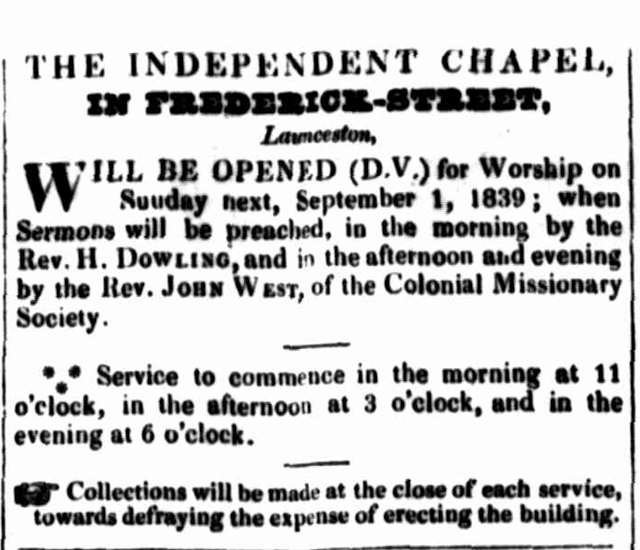
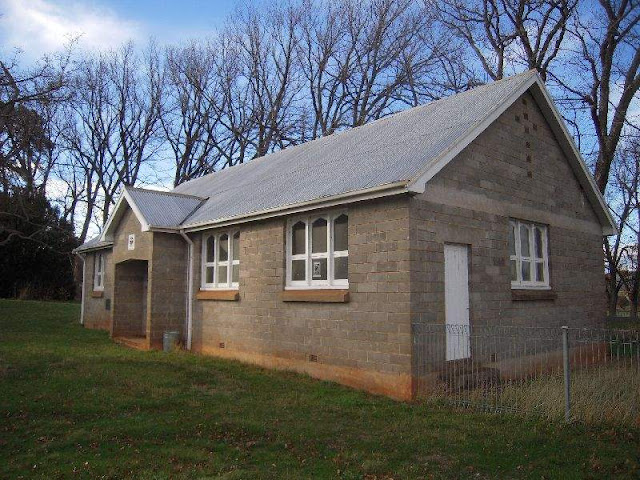
The Frederick Street chapel was a temporary place of worship used from 1839 until 1842 when it was replaced by “St John’s Square Chapel”, now known as Milton Hall. The Frederick Street Independent Chapel was established following a split in the congregation of Charles Price’s Tamar Street Chapel. The new congregation initially met in the Frederick Street Infant School which had opened in 1836. The congregation was led by Reverend John West. West arrived in Tasmania in 1838, having been sent by the Colonial Missionary Society to engage in mission work in the northern districts of this island. West preached in Launceston, where his “gentle winning manner and his deep thoughtful teaching won him a group of followers”. In mid 1839 a small wooden chapel was opened on Frederick Street on a site close to what is now the City Mission. The building acquired for use as a chapel was even “then considered an old one, ….erected in another part of the town ….[and] purchased and removed on wheels t...

No. 1203 - Campbell Town - Adam Turnbull Memorial Hall (1956)

Image
This article is one in a series about buildings associated with some of Tasmania’s most significant churches. These buildings include Sunday schools, parish halls, convents, schools and residences of the clergy. Ancillary buildings are often overlooked and are rarely featured in published histories. My aim is to create a simple record of these buildings, including those that no longer exist. Campbell Town is a sizeable rural centre on the Midland Highway approximately 70 kilometres south of Launceston. It was named by Governor Lachlan Macquarie when his party encamped here in 1821 on their way to Hobart. Macquarie chose the site as one of four garrison towns between Hobart and Launceston. St Andrew’s Presbyterian Church opened for worship on 30 May 1858. The origins of the church are bound to the life to Reverend Adam Turnbull, one time Secretary to Governor George Arthur and to Sir John Franklin. In 1852 Turnbull clashed with Governor Denison in opposing the continued transportation o...

No. 1202 - Hagley - St Paul's Anglican Church (1848-1862)

Image
This ‘blog entry’ is one of a series of articles about places of worship which are barely represented in the historical record. No images of these buildings appear to have survived. My hope is that these brief articles may result in further information and photographs coming to light thus enabling a more complete history to be recorded. Hagley lies about 5 kilometres north-east of the town of Westbury. In the 1820s land grants were made to William Thomas Lyttleton, William Bryan and Sir Richard Dry. Lyttleton was associated with Hagley Hall in England, after which he named his estate and which is the source of the village’s name. St Paul’s was Hagley first Anglican church. It was used as an Anglican church from 1848 to 1862 when it was replaced by St Mary’s church that was built on a new site nearby. St Paul’s was later purchased by the Presbyterians who used it until 1878 when it was demolished to make way for a new Presbyterian church. The foundation stone for St Paul’s was ceremonia...

No. 1201 - Oatlands - Wesleyan Methodist Chapel and Cemetery (1841- c.1911)

Image
The town of Oatlands acquired its name in 1821 when Governor Lachlan Macquarie passed through the area. He noted that it was “a very eligible situation for a town, being well watered and in the midst of a rich fertile country”. A settlement was well established by the late 1820s by which time several cottages, a barracks, gaol and a church had been constructed. The Wesleyan-Methodist Chapel was the second church built at Oatlands, opening in early 1841 after tenders for the construction of a stone building were advertised in June 1840. Built of local freestone, the chapel measured 31 ft. by 21 ft. and had a shingle roof with two windows on either side of the building. Regular services were held until the late 1840s but were discontinued until 1859. Services were irregular due to the small Methodist population and because of difficulties supplying a resident minister. This was a defining feature of the church which remained unused for long periods of time until it was permanently close...