Posts

No. 1222 - Launceston - City Mission Hall - Cornwall Square (1896-1906) "The Bunyan"

Image
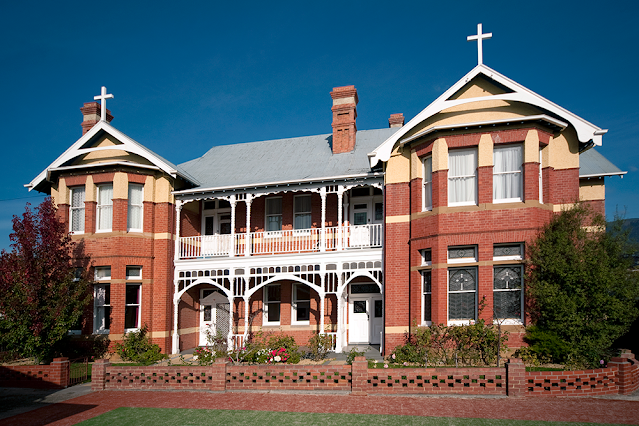
Launceston City Mission was founded in 1854 by a group of prominent citizens who were concerned with the religious and economic welfare of the town’s poor and destitute. William Whitaker was appointed as the first “town missioner”. For the next thirty years the Mission did not have a permanent base and various premises were rented until 1883 the Wharf Mission Hall on William Street became the first permanent premises of the Launceston Town Mission. [ see No. 1174 ] In 1896 the Wharf Mission Hall was moved to a new site off Cornwall Square (then known as Market Green), after the foundry firm of Salisbury and Company acquired the William Street site for the expansion of its business. The new site was on the corner of William and Charles Street. The hall was enlarged and renamed “City Mission Hall”. The Launceston Examiner reported on the reopening that took place on Tuesday 21 January 1896: “The re-opening of the old Wharf Mission Hall, which is to be termed in future the City Mission H...

No. 1221 - Brighton - Brighton Military Camp - YMCA Hut and Chapel (1940)

Image
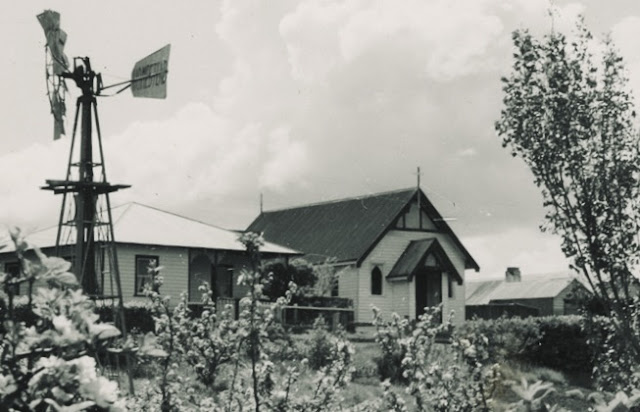
Brighton Military Camp was located at the northern end of of the town of Brighton near Pontville. The camp was established on the 13th August 1914 but lack of water impeded its development. After the first contingent of troops left in October 1914 the main training camp moved to Claremont. During the Second World War a training camp was reestablished at Brighton, where huts housed up to 2400 trainees. As the need for training declined, Brighton Camp was used to detain Italian prisoners of war. After the war the camp was used to house migrants from Europe as well as national servicemen. In 1967 it housed victims of the bushfires and in 1999 it was temporarily used by 400 Kosovar refugees. The facility was closed in 2006 and sold to a developer in somewhat controversial circumstances. During World War Two, the material and religious needs of servicemen at Brighton Camp were met by a number of religious denominations and organisations including Anglican; Methodist; Catholic; Salvation Arm...

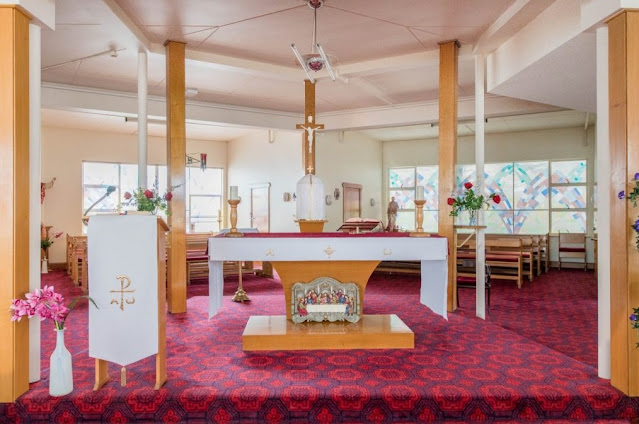
No. 1220 - Ridgeway - St Patrick's Catholic Church (1935-1967)

Image
Ridgeway is a semi-rural district about 7 kilometres south-west of Hobart. Prior to the 1967 bushfires, Ridgeway was a market garden area with its own school, post office and a Catholic church. St Patrick’s Catholic church was one of several churches destroyed in the 1967 fires that swept across southern Tasmania. Ridgeway’s Catholic church was closely associated with the Tagg family. John Tagg (1861-1929) had been head gardener at the Cascade Training School for Boys before he went on to establish an orchard at Ridgeway in the 1890s. The Tagg’s opened a tea room and gardens on their property ‘Homestead’ in the 1920s. John Tagg’s eldest son, George, played a leading role in the cause to build a Catholic church and the family donated land for this purpose. Before the church was built in 1934, Catholic Mass was held monthly in the State school and occasionally at a private house. Fundraising to build a church commenced in 1920 with a Strawberry Feast and Fair held at nearby FernTree. Th...

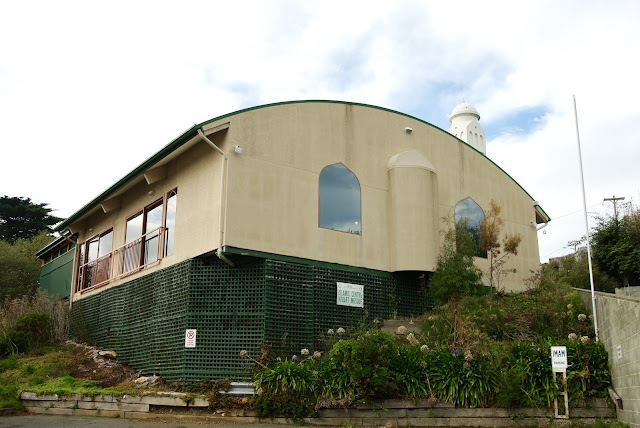
No. 1219 - West Hobart - Warwick Street Mosque (1985)

Image
This is one of a series of articles that explores Tasmanian places of worship other than Christian churches. These buildings include mosques; synagogues; temples and gurdwaras. At least seven 'non-Christian' religious denominations have purpose-built places of worship in the Tasmania. Tasmanian data from the 2021 census reveals that there are almost 5000 people who identify with the Islamic faith. However, the State has only two mosques, one at Kings Meadows in Launceston, and the other, Tasmania’s first mosque, in West Hobart. The Islamic presence in Tasmania dates back to 1807. However, the number of Muslims remained very small until the arrival of post-Second World War migrants. By the 1960s the lack of religious support and organisation was finally addressed: “In 1968 Muslim students in Hobart founded the first Islamic organisation in this State, the Tasmanian Students Islamic Society, to take care of their general and religious concerns. The need for a broader organisation...

No.1218 - Sheffield - Kingdom Hall

Image
Sheffield is a country town in northern Tasmania approximately 25 kilometres south of Devonport. The area was explored by the surveyor Nathaniel Kentish in 1842 who was trying to find a route from Deloraine through to the north west coast. According to J. R. Skemps’ ‘A History of the North West Coast’, in 1861 the first public house, the Sheffield Inn, was opened by James Poulett, a native of Sheffield in England. This is possibly the origin of the town’s name. Sheffield’s Kingdom Hall is located on Albert Street. It is built in the style typical of most of the Kingdom Halls found in Tasmania. No published information about the hall is available. The Jehovah's Witness diverges from the mainstream doctrines of Christianity in that it is a non-trinitarian tradition. Jehovah's Witnesses believe their denomination is a restoration of first-century Christianity. The historical persecution of members of the Jehovah’s Witness in many countries, including Australia, has further contrib...

No. 1217 - Paradise - Gospel Hall (1916)

Image
Paradise is a rural district approximately 8 kilometres south of Sheffield. Its original name was ‘Reuben Austen's Paradise’, after one of the first settlers, who remarked upon seeing the sun glistening on a picturesque mountain vista: "This is Paradise.” This ‘blog entry’ is one of a series of articles about places of worship which are barely represented in the historical record. Often no images of these buildings have survived. My hope is that these brief articles may result in further information and photographs coming to light thus enabling a more complete history to be preserved. In August 1916 an old Christian Brethren Gospel Hall at nearby Beulah was removed to the small settlement at Paradise. The building was dismantled and loaded onto wagons moved in sections across the Dasher River. It was then transported along the old Paradise Road where it was reassembled on a corner of George Morse’s farm. In August 1923 the Gospel Hall was “turned over” in a violent storm and “...

No. 1216 - Hobart - All Saints' Sunday School (1877) "Unwearied zeal and enthusiasm"

Image
This article is one of a series about the history buildings associated with some of Tasmania’s most significant churches. These buildings include Sunday schools, parish halls, convents, schools and residences of the clergy. Ancillary buildings are often overlooked and rarely feature in published histories. My aim is to create a simple record of these buildings, including those that no longer exist. The construction of the landmark All Saints Anglican church on Macquarie Street, South Hobart began in 1858. It is of an early English Gothic design by architect Henry Hunter. Hunter also designed the church’s Sunday school which was completed in 1877. The cost of the Sunday school building, which amounted to £1000, was borne by Alfred Kennerley, a wealthy businessman, philanthropist and premier of Tasmania (1873-1876). Kennerley, and his wife Jane, were staunch supporter of the Church of England. Kennerley made a significant contribution towards the extensions made to All Saint’s Church in ...

No. 1215 - Launceston - Nazareth House (1950)

Image
Nazareth House was established in 1950 by the Poor Sisters of Nazareth, a Catholic Order founded by Victoire Larmenier. The focus of this article is on the history of the founding and development of Nazareth House and its chapel. The origins of Nazareth House date back to the early 1930s when land was purchased at St Leonards upon the direction of Archbishop Hayden for the purpose of building a boys’ orphanage. It was subsequently decided to include homes for the aged as part of the project. In 1940 a bequest of £1500 was made by a Launceston priest, the Very Reverend Patrick Hennessy, which revitalised plans being made to begin construction. However, due to wartime conditions and restrictions, the work was postponed. In 1946 the project was revived by the newly elected Archbishop Dr. Ernest Tweedy. In 1950 a new opportunity arose when “Mount Esk” a 15 acre property, which included an historical home, was purchased by the Catholic Church for £8500. The land acquired in the 1930s was so...

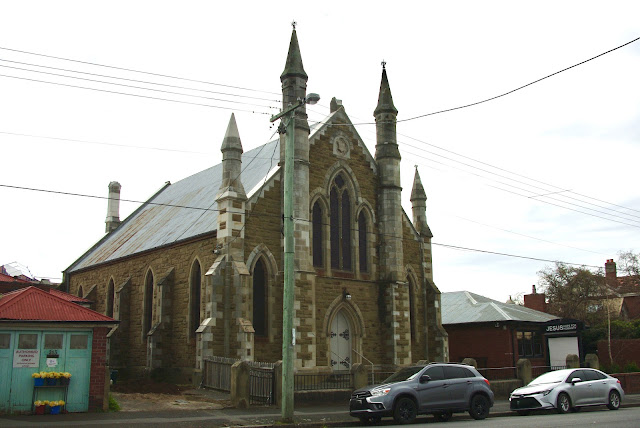
No. 1214 - Hobart - Davey Street Methodist Church (1871-1973) "Simple, cleanly, safe and economical"

Image
For most of its existence, the Davey Street church has been a place of worship for Methodists living in South Hobart. In the 1970s it became a Lutheran Church and in more recent years it was purchased by a Pentecostal congregation. The focus of this article is on church’s establishment through to the final Methodist service held in March 1973. The church’s origins date back to 1834 when a building that had previously been used as a dwelling was secured at 211 Davey Street for use as a Sunday school. Soon after this the property was purchased and a schoolroom and chapel was built and officially opened on 1 April 1838. By the 1860s the Sunday school accommodated 152 students with 14 teachers. By this time the congregation had outgrown the chapel and the construction of a larger place of worship had become a necessity. The foundation stone of a new Wesleyan-Methodist church was laid on 21 July 1870. The Hobart Mercury reported: “Yesterday afternoon the ceremony of laying the foundatio...

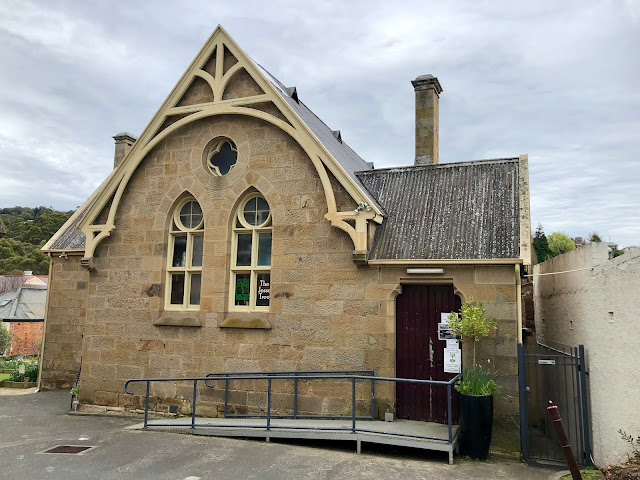
No.1213 - New Town - The Josephite Mission and History Centre

Image
The Josephite Mission and History Centre is located on the campus of Sacred Heart College at New Town. The building began life as the convent for the Sisters of St Joseph of the Sacred Heart of Jesus. In 1908 the Sisters were invited by Archbishop Murphy to take responsibility for the Sacred Heart Parish school that had opened 1888. The Sisters of St Joseph were founded in Penola, South Australia in 1866 with their work and values based on the ideals of the Order's founders, Julian Tenison Woods and Mary MacKillop, who shared a call to help and educate children. In 2010 the covent was redeveloped to house the Josephite Mission and History Centre. The Centre displays the history of the Sister’s of St Joseph who ran 22 Josephite schools across Tasmania. The Centre contains a permanent historical display, a contemporary library of spiritual and Josephite books and several rooms of memorabilia. The Founding Sisters’ Room tells the story of the arrival of the first community of Sisters ...

No. 1212 - Battery Point - St George's Sunday School (1914)

Image
This article is one of a series about buildings associated with some of Tasmania’s most significant churches. These buildings include Sunday schools, parish halls, convents, schools and residences of the clergy. Ancillary buildings are often overlooked and rarely feature in published histories. My aim is to create a simple record of these buildings, including those that no longer exist. Battery Point is an historical inner suburb on the east side of Hobart, fronting onto the Derwent River. The suburb’s name is derived from Mulgrave Battery was established in the 1818 for coastal defence purposes. St George’s Anglican church is one of Hobart’s most photographed churches. However, the St George’s Sunday school, which is situated next to the church, receives almost no attention from photographers or historians. In January 1906 it was decided to build a new Sunday School on land recently bought adjoining the old Sunday school (1851). Construction began on the new school in 1914. An article...