Posts

No. 794 - Leprena Congregational Church (1899 - c.1938)

Image
Leprena is a former settlement on the northern end of the Recherche Bay. The word 'Leprena' is of Tasmanian Aboriginal origin and means 'home'. From the late 19th century up until the 1940s Leprena had an active timber-milling industry. The settlement’s population peaked around the turn of the 20th century by which time Leprena had acquired a school, a public hall, post office, general store and a church. The saw mill's closure in 1938 and destructive bush fires in the following year brought an end to the settlement. There is little information about Leprena’s Congregational church which opened in July 1899. A brief article describing the church’s opening appears the Hobart Mercury. It was an unusual event given the absence of the minister, Reverend Joseph Ebery, who sent his apologies. In lieu of a formal religious ceremony, the occasion was marked by an informal celebration. The Mercury’s correspondent at Leprena reported: “A concert and coffee soiree was held...
No. 793 - Lutana - St Anne's Mission Hall (1924-1974)

Image
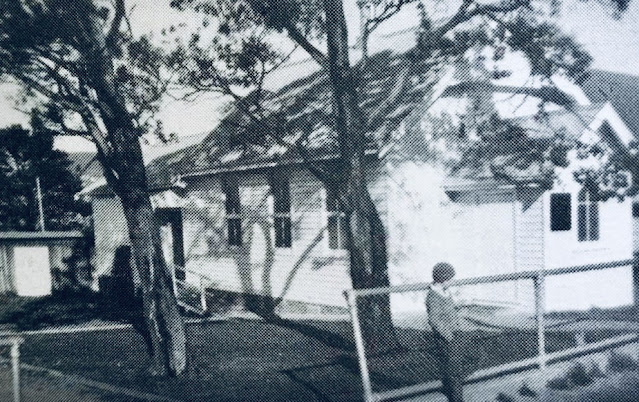
Lutana is a northern suburb of Hobart located on the western shore of the Derwent River and adjacent to the Risdon zinc smelter and refinery. Lutana was originally called Risdon Rise. Following a naming competition run by the Electronic Zinc Company in 1920, when building their new housing estate, the name Lutana was chosen. Lutana is an aboriginal work for ‘moon’. St Anne’s Anglican Mission Hall, which fell within the Moonah Parish, was officially opened and dedicated on Sunday 6 April 1924 by Bishop Robert Hay. Although the event was advertised in the Hobart Mercury, no published description of the ceremony survives thus little information is available about the building’s establishment. A photograph of St Anne’s from the 1960s reveals that the Hall was a simple weatherboard building with a traditional porch with a single gothic style window. An extension at the rear of the church was added at an undermined date and may have accommodated Sunday school classes. The Mission Hall wa...

No. 792 - Evandale Methodist Church - "Going to the Dogs"

Image
Evandale is an historic town situated approximately 20 kilometres from Launceston. Originally established as a military post in 1811, the general area was variously known as Collins Hill, Patersons Plains and Morven. The settlement’s name was changed to Evandale in 1836 in honour of Tasmania's first Surveyor-General, G.W. Evans. The first Wesleyan Methodist Church at Evandale opened in 1836. It was a small brick chapel which still stands on Russell Street. When the building was outgrown the Methodist’s used the Evandale Council Chambers for Sunday school classes and other purposes. However it was not until the 1880s that an opportunity to acquire a new church unexpectedly presented itself. In 1883 a Mission Hall with a “capacity to seat between 150 and 200 people” was built on Macquarie Street. The Mission was established by ‘evangelists’ who secured the financial backing of Mrs Margaret Reed, widow of Henry Reed, founder of the Wellington Street Christian Mission in Launcesto...

No. 791 - Risdon Vale - The Christian Family Centre

Image
Risdon Vale is a suburb of Greater Hobart. It was built by the Housing Department in the late 1950s and it is also the location of the Risdon Prison Complex. The Christian Family Centre is associated with CRC Churches International, formerly known as the Christian Revival Crusade. This is a Pentecostal Protestant Christian denomination founded in New Zealand and Australia by Thomas Foster (Melbourne) and Leo Harris (Adelaide). The Christian Family Centre was established in 1979 In addition to regular Sunday worship the church is engaged in charitable work to support families in need through food relief and other practical support. It works with prisoners and the homeless to relieve their distress through the social and spiritual agencies of the Church. The church serves the Risdon Vale community and supports families and children of prisoners incarcerated in Risdon Prison. In 2016 the Christian Family Centre received a $50,000 community infrastructure grant from the Tasmanian Commun...

No. 790 - Lauderdale - St Wilfred's Anglican Church

Image
Lauderdale is a town in the Greater Hobart region which is located on an isthmus separating Ralphs and Fredrick Henry Bay. The area was previously known as Ralphs Bay and was renamed Lauderdale in 1966. The new name was taken from the property 'Lauderdale' owned by the early Quaker settler, Robert Mather. Lauderdale is a district in the Scottish Borders. Before a church was built Anglican services were held in the Lauderdale Community Centre. In December 1965 a timber church was opened. St Wilfred’s was consecrated in 1968 under the charge of the Sandford parish. A new Besser Block hall was added to the side of the church in 1972. St Wilfred’s closed in the 1990s and the building was subsequently sold. Additional information about this church is most welcome as all articles are continually updated. I can be contacted through this page or my Facebook page "Churches of Tasmania" which is linked here: Churches of Tasmania .            St Wilfred's (c.1990) ...

No. 789 - Forest - St Peter's Anglican Church - "The English Church in the Forest"

Image
Forest is a small settlement off the Bass Highway about 12 kilometres south of Stanley in Tasmania’s far North West. The early settlers referred to the area as "the forest" and when an official name was needed it became "Forest". St Bartholomew’s Anglican Church (1905) was preceded by a much earlier church established in the vicinity of Forest in the 1850s. Little is known about the ‘Forest Chapel’ which appears to have been a short-lived and simple building. It was built in 1857 and used until at least the 1870s. The precise location of the chapel is not known although it is very likely to have been situated next to a former Anglican cemetery on Ford’s Hill Road. Anglican services were held at ‘The Forest’ from the early 1850s. In 1854, the Bishop of Tasmania, Francis Russell Nixon, visited Circular Head on an expedition through the Bass Strait aboard the government schooner “Beacon”. Nixon was a keen sketcher and painter and used his talent to record his trav...

No. 788 - Deloraine - 'The Church of the Latter Day Saints'

Image
Deloraine is a historic tourist town situated on the Meander River and lies approximately halfway between the cities of Launceston and Devonport. The settlement dates to the 1830s and was named by the surveyor, Thomas Scott, after Sir William Deloraine, a character in Sir Walter Scott's poem "The Lay of the Last Minstrel".  Sir Walter Scott was a relative of Thomas Scott. The Church of Jesus Christ of Latter-day Saints (LDS) dates back to 1854, when Robert Owen began to proselytise in Hobart. This mission was however unsuccessful and it was not until the 1890’s that congregations was established in Hobart and Upper Huon. Chapels were built in North Hobart in 1924 and in Glen Huon in 1927. Many early converts migrated to Utah which was a cause of opposition to the 'Saints' proselytising by the Australian government. The Latter Day Saints established a ward (parish) at Deloraine in 1995. Prior to this members of the LDS had to travel to Launceston for meetings. O...

No. 787 - Rokeby - St Matthew's Anglican Church - 'A Monument to Bobby Knopwood'

Image
Rokeby is an eastern suburb of Greater Hobart on the east bank of the Derwent River. It remained a small village until the State Government’s Housing Department built a large public housing estate in the 1970s. Rokeby is named after "Rokeby House”, built by George Stokell in 1830, which in turn remembers the village of Rokeby in Yorkshire.In 1821 the first Anglican service at Rokeby (then Clarence Plains) was conducted by Reverend Robert Knopwood, the first chaplain of Van Diemen’s Land. Following a public meeting in January 1828, tenders were called for the construction of a church. The Colonial architect, John Lee-Archer, oversaw the tenders but for reasons not known, the project did not proceed. (see plans of the 1828 church below). When Knopwood’s retired to the district in 1829, he continued to hold services in the local schoolhouse, until his death in September 1838. Perhaps Knopwood’s death was the catalyst for the planned church to be resurrected. In June 1839, the Ar...