Posts

No. 784 - Longford - Woolmers Convict Chapel

Image
Longford is an historical country town approximately 25 kilometres south of Launceston. The district around Longford was first known as the Norfolk Plains after the Norfolk Islanders who were resettled here in 1813. The town itself developed in 1827 and in 1833 it was named Longford, after the County Longford in Ireland. The Woolmers Estate is situated approximately 2 kilometres south east of Longford. Woolmers is one of the most intact 19th century homesteads in Australia. It is listed as one of Australia's 19 UNESCO World Heritage sites. Woolmers was continuously farmed by six generations of the Archer family from its settlement around 1817 to the death of the last heir in 1994. The property is now owned by a private trust. The Woolmers Estate comprises of more than 18 historic buildings and structures spread over 13 hectares. The farm is also significant for its use of convict labour through the assignment system. A chapel (now an apple packing shed) was built on the Estate in ...

No. 783 - Bellerive - St Mark's Anglican Church 'One Rood and Seven Perches"

Image
Bellerive is a suburb of Hobart located on the Eastern Shore of the Derwent River. Originally it was named Kangaroo Point but in the 1830s this was changed to Bellerive, meaning ‘beautiful shore’. St Mark’s, the second Anglican Church established at Bellerive, is situated on the corner of Clarence Street and Scott Street. The earlier church, also dedicated to St Mark, opened in 1852. It remains relatively unchanged and is to be found two blocks away in Queen Street. [ see. No. 760 ] The move to build a new church began on Friday 8 August 1890, when the Parish Council proposed that a new building had become necessary due to the increasing population of the suburb and “on account of the present edifice falling into decay”. It was to take over a decade of fundraising to bring the plan to fruition. The foundation stone for the new church was laid on Saturday 21 October 1903 by the Governor of Tasmania. Construction was completed in about six months and it was opened and consecrated...

No. 782 - Longford - Wesleyan Chapel (1837-1880)

Image
Longford is an historical country town approximately 25 kilometres south of Launceston. The district around Longford was first known as the Norfolk Plains after the Norfolk Islanders who were resettled here in 1813. The town itself developed in 1827 and was originally called Latour. In 1833 it was renamed Longford, after the County Longford in Ireland. The Longford Wesleyan movement began in 1834 under the guidance of Reverend John Manton of Launceston. The first meeting was held in ‘Lawrence’s barn’, on a farm adjoining ‘Northbury’. In 1837 a chapel opened in Wellington Street that was built on land donated by Joseph Heazlewood. A short report in the Launceston Advertiser provides a record of the occasion: “On Tuesday last, the new Wesleyan Chapel at Longford was opened for public worship. The building is a very neat erection capable of accomodating 300 persons. A sermon was preached on the occassion by the Rev. Mr. Butters, Wesleyan Missionary, from Hobart Town…”. The church was ...

No. 781 - Roland - Christian Brethren Gospel Hall

Image
Roland is a rural village on the Staverton Road approximately 10 kilometres south of Sheffield. It was the railhead of a line that branched off the Main Line at Railton. The name of the settlement changed several times. At the time of the Great War, it was known as Staverton Railway, then it changed to Dasher (after the nearby river) until 1919. After that it became Roland, in honour of Captain Rolland, an early explorer in the district. In the summer of 1918, a year after the Rowland Gospel Hall had been built, a correspondent writing to the Weekly Times in Melbourne, described the settlement at Roland: “At the Staverton railway terminus, which is about 1½ miles from here, there is a store, a blacksmith's shop, shoemaker's, church, post-office, and weighbridge. The station is rapidly growing. When it was first built it consisted only of the station houses and  buildings. The station is a very busy place now, as all the ore from the Round Hill mine, and produce from Wilmot and ...

No. 780 - Howrah - St Thomas the Apostle

Image
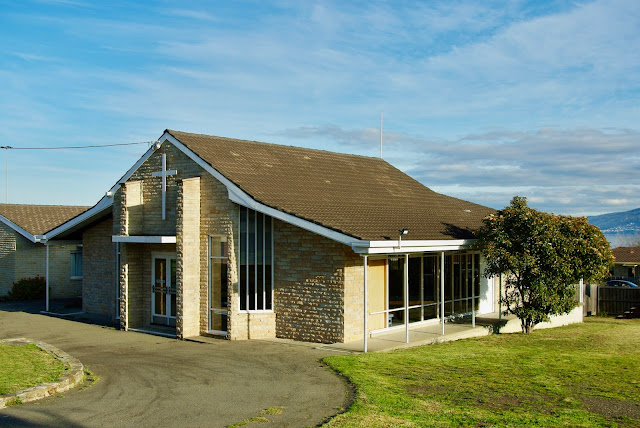
Howrah is a suburb of Greater Hobart that lies on the eastern shore of the Derwent River. It is named after "Howrah House", a property built in the 1830's on the Clarence Plains by a retired Indian Army officer, Captain James Fielder. Howrah is a suburb of Calcutta, where Captain Fielder was stationed. St Thomas’ the Apostle belongs to Anglican Parish Of Howrah-Sandford. With the closure and sale of St Martin’s (Sandford), St Barnabas (South Arm) and St Mathew’s (Rokeby), it will be the only surviving Anglican church in the parish. St Thomas was opened and dedicated on 26 July 1970 and consecrated on 8 September 1991. The building, whose dominant features are white stone and glass, was deigned by S.P. King. Additional information about this church is most welcome as all articles are continually updated. I can be contacted through this page or my Facebook page "Churches of Tasmania" which is linked here: Churches of Tasmania . All photographs used in this artic...

No. 779 - Coningham - Montgomery Park Chapel (1990 - 2010)

Image
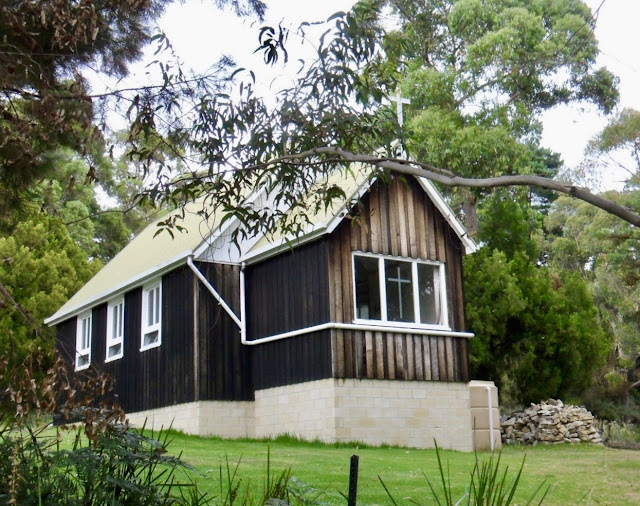
Coningham is a small settlement 3 kilometres south east of the town of Snug. Previously known as ‘little Snug’ it was renamed after a County in Buckingham, England. The only church at Coningham was a chapel located at Montgomery Park, a former Anglican Youth and Conference Centre. In 1947 Mrs Hedley Allen donated land to the Anglican church for the development of a youth centre at Coningham. Mrs Hedley requested that it be named Montgomery Park in honour of the fourth Anglican Bishop of Tasmania, Henry Montgomery, as well as his son, Field Marshall Bernard Montgomery. In November 1947 the Mercury reported: “Two and a half acres of land at Little Snug, given by Mr H. Allen, of Snug, for a youth and recreational centre, is to be known as Montgomery Park….This was announced by the Bishop of Tasmania (the Rt Rev G. F. Cranswick) at an informal gathering of youth leaders in Hobart on Monday…. Announcing acceptance of the offer by the Church of England,…. plans for clearing the land and bu...

No. 778 - Waratah - Wesleyan-Methodist Church (1878-1912)

Image
Waratah is a former mining town located approximately 80 kilometres south of Burnie. Waratah was briefly the site of the largest tin mine in the world. The town had its beginnings in 1871 when James "Philosopher" Smith discovered tin at Mount Bischoff. The population of Waratah reached 2500 at its peak but is now under 300. The town was once connected to the Emu Bay Railway by a branch line which opened in 1885. Six religious denominations were established at Waratah which included three Methodist churches: A Wesleyan Methodist church (1878 -1912); A Primitive Methodist church (1882-1884); and a new church built after Methodist Union in 1902 (1912-1949). The first church established at Waratah was a Wesleyan Methodist Church that opened on Sunday 14 April 1878. This was a small weatherboard building “erected chiefly by the exertions of the Rev. J. May, Circular Head”. The church’s opening is described in a report by the Hobart Mercury’s correspondent for Waratah: “A very inte...

No. 777 - Ulverstone Kingdom Hall

Image
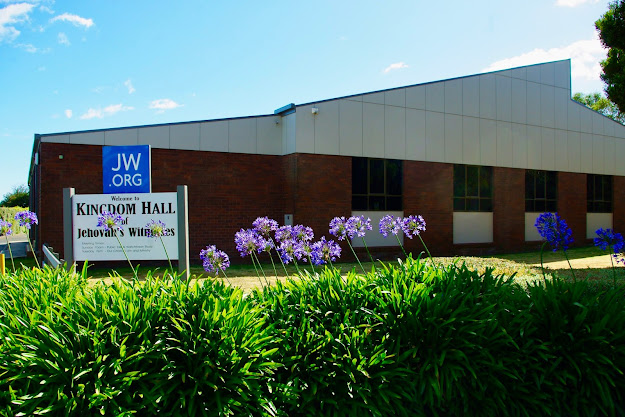
Situated on the north west coast of Tasmania, Ulverstone is a town of many churches with 18 denominations established during its 170 year history. The Jehovah’s Witness Kingdom Hall, situated on Allambie Crescent, is one of the more recent additions to the town .  The Jehovah's Witness first worshipped in Lakin's Hall which was located on Crescent Street, now the site of Woolworths. In about 1972 a Kingdom Hall was established at 26 Leven Street. (This is now used by The Church of Christ). The Jehovah's Witness vacated the Leven Street property after the Allambie Crescent Hall was built in 1988. In 2017 the Jehovah's Witness at Ulverstone merged with the Devonport church. In 2018 the Allambie Crescent Kingdom Hall was sold to the Life Christian Church. The Jehovah's Witness diverges from the mainstream doctrines of Christianity in that it is a non-trinitarian tradition. Jehovah's Witnesses believe their denomination is a restoration of first-century Christianit...

No. 776 - Sorell - The Uniting (Presbyterian) Church (1842)

Image
Sorell is one of Tasmania's oldest towns with the region first settled in 1808. Sorell was formally established as a township in 1821 and was named after William Sorell, who served as Lieutenant-Governor from 1816 to 1824. Sorell’s former Uniting Church was established as a Presbyterian Church in the early 1840s. The foundation stone for the church was ceremonially laid on Thursday 16 July 1840 and the building was completed almost two years later, opening on Sunday 24 April 1842. The land for the church had been donated by Andrew Counsel and the architect was James Blackburn. Difficulties in securing regular services of a minister resulted in the church being unused for many years and the building fell into disrepair. The irregular use of the church resulted in it becoming a target of vandalism. In November 1870 the Tasmanian Times reported: “At a recent sitting of the Sorell Police Court, …..Lewis Quinn, William Hollingsworth, William Weaver, and Edward Blackmore, young boys, we...

No. 775 - Howrah - Church of Christ

Image
Howrah is a suburb of Hobart situated on the eastern side of Bellerive on the shores of the Derwent River. It is named after "Howrah House", a property built in the 1830's on the Clarence Plains by a retired Indian Army officer, Captain James Fielder. Howrah is a suburb of Calcutta, where Captain Fielder was stationed. Howrah has had five religious denominations active in the suburb since it was was settled. The ‘Churches of Christ’ believe that Christian communities should be similar to those described in the New Testament, with simple and autonomous congregations. The Church of Christ has some similarities with the Christian Brethren, although it is influenced by American rather than British churches. The first members of the Church of Christ arrived in Tasmania in 1865. In the 1870s churches were set up in Launceston and Hobart. The first followers were initially known as ‘Christians' then from 1885 as 'Disciples of Christ' and from 1915 as 'Churches ...

No. 774 - Forest - St Patrick's Catholic Church - 'Blown Down and Blown Up'

Image
Forest is a small settlement off the Bass Highway close to Stanley in Tasmania’s far North West. The early settlers referred to the area as "the forest" and when an official name was needed it became "Forest". Several churches have been established at Forest including, Baptist, Anglican, Christian Brethren and Catholic.  Forest long had a small but devout Catholic community but it was the arrival of the prolific church-builder, Father T. J. O’ Donnell in July 1909 that provided the catalyst for building a church. Father O’ Donnell wasted no time for in August 1909 The Circular Head Chronicle reported: “Father O’Donnell is having plans drawn for the new Catholic church to be erected at Forest…. Father O’ Donnell is soliciting subscriptions for the building fund, and to augment it a grand bazaar will shortly be held…..The Catholic people of Forest district are delighted at the prospect of soon having a decent place of worship, and are enthusiastically aiding their ne...

No. 773 - Launceston - The Queen's Head Inn - St John's Mission House and Chapel - "Well done thou good and faithful servant"

Image
Nineteenth century Launceston’s growth was matched by a sizeable increase in the town’s underclass. A significant number of families lived in extreme poverty and delinquent children were of particular concern to the authorities. After the mid 19th century the issue of poverty was gradually taken on by government as well as charitable bodies and churches. The arrival of the Salvation Army in Launceston in the early 1880s and its relentless proselytising amongst the town’s poor challenged the established churches to respond to the spiritual and material needs of the poor; especially those who had abandoned religion. One such example of this response was that of the Anglican Church which established St John’s Mission House in 1893. During the incumbency of the rector of St John’s Church, Reverend Cannon R. C. Nugent Kelly, a mission was opened in the ‘Queen’s Head’ public house on Wellington Street. The Queens Head had been refused a renewal of its license due to “Ill-regulated business...