Posts

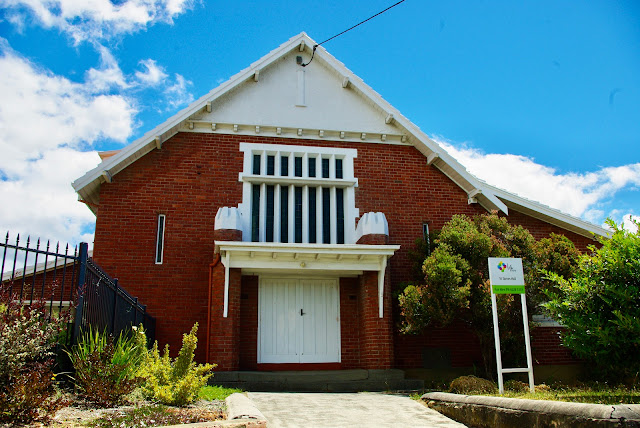
No. 1108 - West Hobart - St Volodymyr
Image
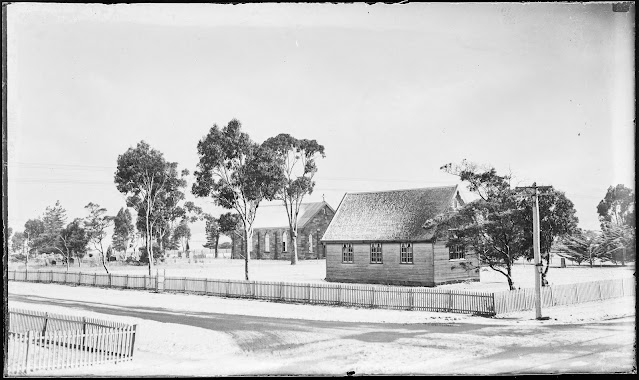
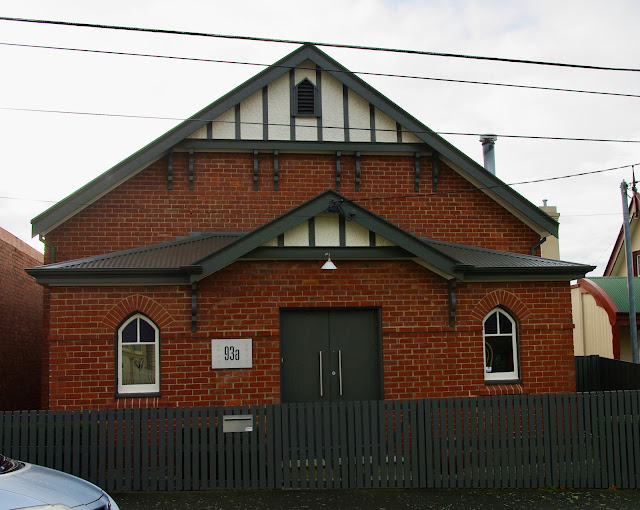
West Hobart is an inner-city suburb of Hobart immediately west of the city centre. The suburb occupies the high ground below Knocklofty Hill. The church was built in 1923, and was known as the Church of Christ. It continued to be known as the Church of Christ at least until the late 1940s. [ See No. 984 ] It later became a Ukrainian Orthodox Church, named St Volodymyr and was consecrated by Archbishop Andrew of Edmonton, Canada, on 28 November 1971. The church has since been de-consecrated and is now a private residence. Source: https://westhobart.wordpress.com/st-vlodymyrs/
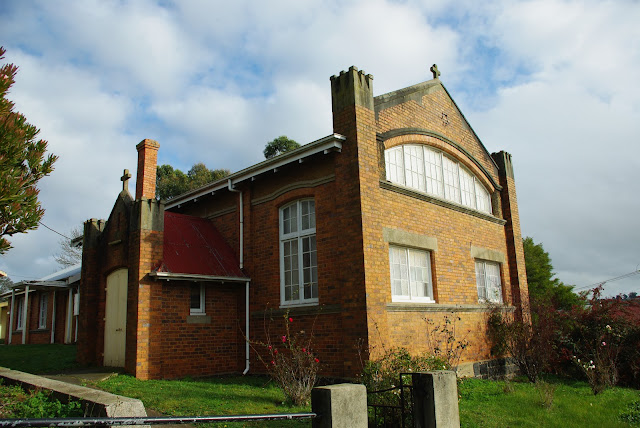
No. 1107 - Hobart - Holy Trinity Greek Orthodox Church

Image
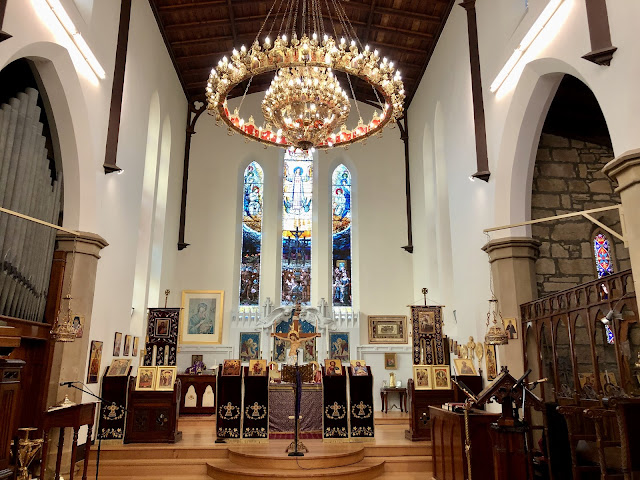
Holy Trinity Church is a former Anglican, and now Greek Orthodox church. The church was designed in the Gothic Revival style by James Blackburn and consecrated in 1849. A detailed history of the church is located here: [ No. 996 ] In February 2007 a report found that more than $5 million was needed to restore the church and that it was unrealistic for the parish to continue maintaining all its properties. In March 2007 the parish council petitioned the Bishop of Tasmania, Rt. Rev. John Harrower, to deconsecrate the building. In August the decision to close the church was made and a final service was held on 28 October 2007. The Holy Trinity Church Charitable Trust was formed in November 2007 in an effort to restore and preserve the building. The Trust asked the Anglican Church to transfer the property to them, but it was instead sold to the Greek Orthodox Archdiocese of Australia. As of 2015, extensive repairs had started on the church. Further information: https://www.abc.net.au/news/...

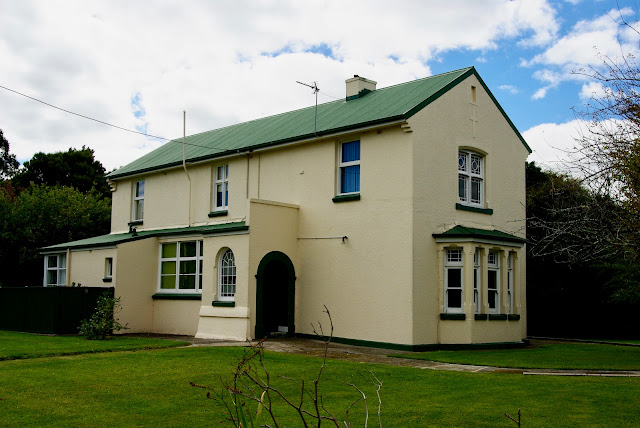
No. 1106 - Scottsdale - St Barnabas' Parish Hall (1916)

Image
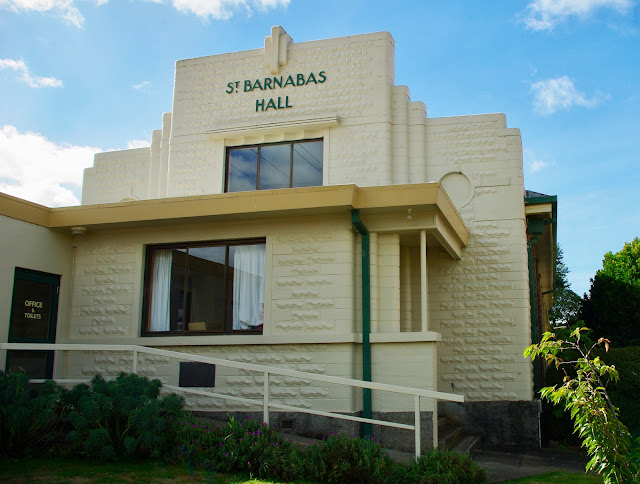
This entry is another in a series of articles concerning buildings associated with some of Tasmania’s most significant churches. These buildings include Sunday schools, parish halls, convents, schools and residences of the clergy. Ancillary buildings are often overlooked and are rarely featured in published histories. My aim is to create a simple record of some of the most significant of these buildings, including some which no longer exist. Scottsdale is the largest town in north-east Tasmania. It is named after the Government Surveyor, James Scott, who explored the region in the 1850s. The town was initially planned around Ellesmere but it developed about a kilometre south of the original site and was officially called Scottsdale after 1893. St Barnabas’ Anglican church opened in 1892. In 1916, a new parish hall was built alongside the church. The foundation stone for the hall was laid by Governor William Ellison-Macartney. The ceremony was reported by the Hobart Mercury: “Friday las...

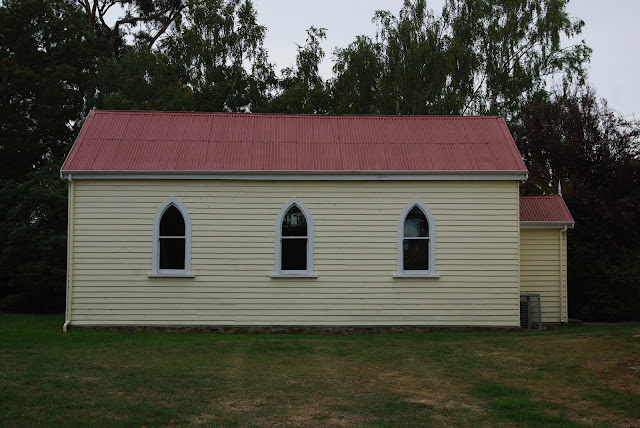
No. 1105 - Hobart - Melville Street Uniting Church

Image
The Melville Street Uniting Church is one of Hobart's oldest original churches still in use. Construction of the church began in 1837. It was designed and built by Henry Chapman and was closely modelled on the City Road Wesleyan Chapel in London. The church, called the Wesleyan Centenary Chapel, opened in 1840. Its name commemorated the beginning of John Wesley’s Methodist movement in 1738. The history of Wesleyan Methodism in Tasmania dates back to 1820 when Reverend Benjamin Carvosso stopped off at Hobart while on route to Sydney, on the instruction of the Methodist Mission Board. From the steps of the Hobart Town Court House, Carvasso preached the first Methodist sermon in the colony. In August 1821, the ship Brixton, en route to New South Wales from England, called at Hobart. Among the passengers were three Methodist missionaries - the Revs. S. Leigh, W. Horton, and W. Walker. In view of the need for a resident minister, Reverend Horton agreed to remain and assume the administr...

No. 1104 - Tullah - Sacred Heart Catholic Church (c.1932)

Image
Tullah is a small town on the Murchison Highway approximately 110 kilometres south of Burnie. It was established in 1900 as a remote mining settlement known as Mount Farrell. In the 1970s Tullah was used by the Hydro Electric Commission to house workers engaged in the various parts of the Pieman River Power Scheme. At this time Tullah’s population peaked at 2500. The town is divided into two sections; the older northern mining settlement and the newer southern part developed by the Commission. Four churches were built at Tullah representing the Methodist, Catholic and Anglican denominations. These have all closed and in recent years were replaced by the Tullah Community Church. The history of Tullah’s Catholic church is not well established. Shortly after the turn of the 20th century Catholic services were held at Kelly’s Hall. In 1910 Archbishop Delany visited the town to conduct a confirmation service. About twenty years passed before a church was built. The year in which the church...

No. 1103 - Launceston - Chalmers' Hall (1928)

Image
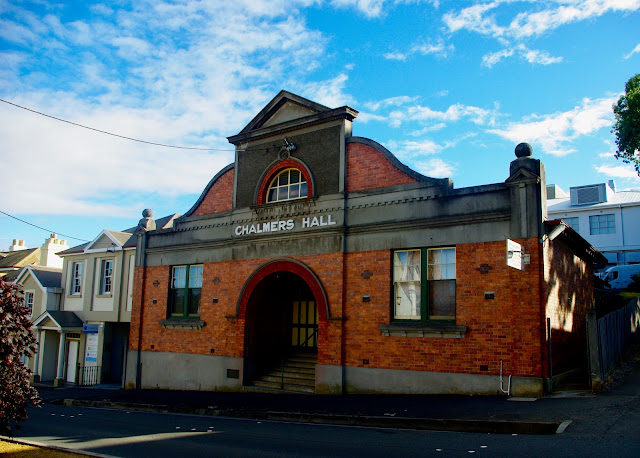
This entry is another in a series of articles concerning buildings associated with some of Tasmania’s most significant churches. These buildings include Sunday schools, parish halls, convents, schools and residences of the clergy. Ancillary buildings are often overlooked and are rarely featured in published histories. My aim is to create a simple record of some of the most significant of these buildings, including some which no longer exist. Launceston’s iconic and much photographed Chalmers’ Presbyterian church has a lessor known but equally striking companion, the Chalmers Hall, which is located diagonally opposite the church. For many years it served as a parish hall and a Sunday school. The hall’s foundation stone was laid on Thursday 22 December 1927 by Mr David Storrer, a former mayor of Launceston and member of the House of Assembly. The Launceston Examiner reported on the occasion and provided details of the building features: “Designed by the well known Launceston architect, M...

No. 1102 - Northdown - St James' Parish Hall and Sunday School (1909)

Image
This entry is another in a series of articles concerning buildings associated with some of Tasmania’s most significant churches. These buildings include Sunday schools, parish halls, convents, schools and residences of the clergy. Ancillary buildings are often overlooked and are rarely featured in published histories. My aim is to create a simple record of some of the most significant of these buildings, including some which no longer exist. Northdown is a fertile agricultural district 15km east of Devonport. In 1826 the area was settled by Captain Bartholomew Thomas, who established the Northdown estate. Captain Thomas met a violent death in 1831 when he and his overseer, Mr Parker, were speared to death by a group of men from the ‘Big River tribe’. St James’ was opened in May 1878 and the church and burial ground were consecrated on 30 January 1879 by Bishop Charles Bromby. In October 1909 a Sunday-school and hall was opened by Bishop Mercer. The following report, published in the No...

No. 1101 - Dundas - St David's Anglican Church (1911)

Image
Dundas was a mining township located about 5 kilometres east of Zeehan in Western Tasmania. Silver was discovered in the Mount Dundas area in 1890. The Mount Dundas Post Office was opened by the end of 1890 and settlement’s name was shortened to Dundas in 1892. Dundas’ population peaked at around 1000 in the mid 1890s but gradually declined over the next three decades until the settlement was swallowed up by the bush. Little is known about Dundas’ Anglican church which only functioned for a handful of years. No photograph of the church appears to exist. Dorothea Henslowe’s ‘Our heritage of Anglican churches in Tasmania’ states that “a corrugated iron building was turned into a church” at cost of £45. In December 1911, the Hobart Mercury reported: “Bishop Mercer arrived a Zeehan yesterday, and in the afternoon conducted a confirmation service… he visited Dundas, and held a service in the new church, but, as the building is not quite completed, the proposed dedication ceremony was not...

No. 1100 - New Town - St James' Parish Hall (1922)

Image
This entry is another in a series of articles concerning buildings associated with some of Tasmania’s most significant churches. These buildings include Sunday schools, parish halls, convents, schools and residences of the clergy. Ancillary buildings are often overlooked and are rarely featured in published histories. My aim is to create a simple record of some of the most significant of these buildings, including some which no longer exist. New Town is a northern suburb of Hobart. It is also one of Hobart’s oldest suburbs and consequently the area contains many historic churches. New Town became a municipality in 1907 but was absorbed into Greater Hobart in the 1920s when its municipal status was relinquished. St James’ Anglican church was built on Augusta Road in 1916. A parish hall was built alongside the church in 1922 with the foundation stone ceremonially laid by Bishop Hay on Saturday 17 June. The building was officially opened by the Premier of Tasmania, Mr John Hayes, on Wedn...

No. 1099 - Deloraine - St Mark's Parish Hall (1916)

Image
This entry is another in a series of articles concerning buildings associated with some of Tasmania’s most significant churches. These buildings include Sunday schools, parish halls, convents, schools and residences of the clergy. Ancillary buildings are often overlooked and are rarely featured in published histories. My aim is to create a simple record of some of the most significant of these buildings, including some which no longer exist. Deloraine is an agricultural and tourist centre situated on the Meander River and lies approximately halfway between the cities of Launceston and Devonport. The first Anglican church at Deloraine was a wooden structure built in 1845. The present church, St Mark’s, was completed in March 1859. The hall was officially opened on Thursday 17 August 1916 by Reverend H. N. Baker. The hall’s foundation stone had been laid earlier in the year by Governor Macartney. A report in Launceston’s Daily Telegraph describes the building as follows: “The hall stands...

No. 1098 - Latrobe - St Patrick's Presbytery (1879)

Image
This entry is another in a series of articles concerning buildings associated with some of Tasmania’s most significant churches. These buildings include Sunday schools, parish halls, convents, schools and residences of the clergy. Ancillary buildings are often overlooked and are rarely featured in published histories. My aim is to create a simple record of some of the most significant of these buildings, including some which no longer exist. Latrobe is a large country town situated between the Bass Highway and the Mersey River. It is named after a government administrator, Charles LaTrobe, who was acting Lieutenant-Governor of Tasmania for a a matter of months (1846-7). Latrobe was once an important port town with boats operating from Bells Parade until the Mersey River silted up. St Patrick’s Catholic church opened in 1871. The church’s presbytery was built in 1879 by William Gadsby, who also built Latrobe’s Methodist church. In 1926 the building was slightly damaged in a fire. A seco...

No. 1097 - Evandale - St Andrew's Sunday School (1904)

Image
This entry is another in a series of articles concerning buildings associated with some of Tasmania’s most significant churches. These buildings include Sunday schools, parish halls, convents, schools and residences of the clergy. Ancillary buildings are often overlooked and are rarely featured in published histories. My aim is to create a simple record of some of the most significant of these buildings, including some which no longer exist. Evandale is an historic town approximately 20 kilometres from Launceston. Originally established as a military post in 1811, the general area was variously known as Collins Hill, Patersons Plains and Morven. The settlement’s name was changed to Evandale in 1836 in honour of Tasmania's first Surveyor-General, G.W. Evans. On approaching Evandale from Launceston, Saint Andrew’s Anglican church dominates the village’s skyline. Built in 1872, the church replaced an earlier building constructed in 1837. St Andrew’s Sunday school opened on Wednesday ...

No. 1096 - Sorell - St George's Memorial Sunday School (1894)

Image
This entry is another in a series of articles concerning buildings associated with some of Tasmania’s most significant churches. These buildings include Sunday schools, parish halls, convents, schools and residences of the clergy. Ancillary buildings are often overlooked and are rarely featured in published histories. My aim is to create a simple record of some of the most significant of these buildings, including some which no longer exist. Sorell is one of Tasmania's oldest towns with the Pittwater district being settled in 1808. Sorell was formally established as a township in 1821 and was thereafter named after William Sorell, who served as Lieutenant-Governor from 1816 to 1824. In 1894 the Hobart Mercury reported that the “corner stone” of St George’s Sunday school was laid on Wednesday 8 August by Mrs Montgomery, wife of the Bishop of Tasmania. The building, known as the “St George’s Memorial Sunday School” was officially opened on Friday 12 October 1894. The Mercury provide...

No. 1095 - Alberton - Methodist Church (1894 - c.1929)

Image
This is another in a series of short articles about minor churches that have left little trace in the historical or photographic record. Among the objectives of this blog is to create a definitive catalogue of all churches and other places of worship that have existed in Tasmania since settlement. My hope is that the publication of basic details about these buildings might result in further information and photographs coming into the public domain. Alberton is a former mining town located approximately 8 kilometres south of Ringarooma. It lay at the junction of New River Road and Alberton Road, on the banks of the Dorset River below Mount Victoria. It is thought to have been named in honour of Prince Albert who visited Tasmania in 1867. At its peak Alberton and its mining camps had a population of about 800. In the mid 1880s the town had several stores, two hotels, a post office, a school and a Methodist church. The Anglican’s acquired land in the township to build a church but this d...

No. 1094 - Sheffield - Baptist Hall (1952)

Image
This entry is another in a series of articles concerning buildings associated with some of Tasmania’s most significant churches. These buildings include Sunday schools, parish halls, convents, schools and residences of the clergy. Ancillary buildings are often overlooked and are rarely featured in published histories. My aim is to create a simple record of some of the most significant of these buildings, including some which no longer exist. Sheffield’s Baptist church was officially opened on 31 January 1931. The brick building replaced an weatherboard church (1891) that was destroyed in a fire in March 1930. In 1952 a new Sunday school hall was opened alongside the church. The opening of the hall on Saturday 17 May is described in a report carried by The Advocate: “The new Baptist Sunday school hall was opened by the president of the Tasmanian Baptist Union (Rev. J. Roberts Thomson), in the presence of a large gathering. The golden key was then handed to the building secretary (Mr. ...